

Table of Contents

The Real Reason Lymphatic Massage Matters: Where Does Brain Waste Go?
Hello, I’m Dr. Sangchul Hwang, a researcher and therapist of autonomic nervous system. Some of my patients ask me, “Isn’t the blood just important? Isn’t the lymph important enough to care about?” While many people are familiar with blood circulation, lymphatic circulation is often thought of as simply draining swelling. However, recent studies have shown that lymph is not just a drainage pipe, but an important system that is closely linked to immunity, waste removal, and even brain health.
What is a limb?
There are two main circulatory systems in the body. One is the blood vessels and the other is the lymphatic vessels. It’s easy to understand if you think of the blood vessels as the water pipes that deliver oxygen and nutrients, while the lymphatic system is the sewer and water treatment plant that collects waste. As blood passes through the capillaries, some of it leaves the blood vessels and becomes tissue fluid – about 20 liters per day travels to the tissues. Of this, about 17 liters is absorbed back into the veins, but about 3 liters is left between tissues. The lymphatic system is responsible for collecting this remaining water and protein and returning it to the blood.
Why lymph is important
The lymphatic system doesn’t just collect leftover water; it also performs immune functions by filtering harmful substances like bacteria, viruses, and cancer cells out of the lymph nodes, and it’s also involved in the absorption of fats and fat-soluble vitamins in the small intestine. In other words, if the blood vessels are the supply system, the lymphatic system is the immune system in charge of cleaning and defense.
How does lymph circulate?
Lymphatic circulation begins in the capillaries. These very fine, straw-like lymphatic vessels are densely distributed between the skin and muscles, where they absorb water, proteins, and waste products that remain between tissues. Later, several lymph vessels join together to form larger lymphatic vessels and pass through lymph nodes along the way. When you have a cold, your throat is swollen or you feel sore under your chin, it’s because your lymph nodes are full of immune cells.
Why the cervical vein angle is important
After circulating throughout the body, lymph eventually joins the veins at a place called the cervical venous angle. The cervical venous angle is where the internal jugular vein and subclavian vein meet in the front of the neck. Lymph from the right head and neck, right arm, and part of the right chest converge at the right venous angle, while most of the rest of the lymph travels through the chest tube to the left venous angle. In layman’s terms, the cervical venous angle is the final destination for lymph after it has been cleaned throughout the body.
Brain waste is also flushed out through the lymphatic system
Recent studies have shown that waste products from the brain are also discharged through the lymphatic system. Wastes produced by the brain, such as amyloid beta and tau proteins, travel with the cerebrospinal fluid, pass through the meningeal lymphatics, nasopharyngeal lymphatics, and cervical lymphatics, and eventually drain into the venous system near the cervical venous angle. These findings have important implications for the field of dementia research, and understanding the pathways of brain waste clearance is becoming a key topic for future neurodegenerative disease research.
Factors that impede lymphatic circulation
As we age, our blood vessels and lymphatic vessels can become less elastic and less functional. In addition, a sedentary lifestyle, stiff neck and shoulders, and lack of exercise can make lymphatic circulation difficult. Add to that ongoing stress, and the sympathetic nervous system can become overactive, causing blood vessels and lymphatic vessels to remain under tension, creating an environment where lymph flow is impaired.
Lymphatic vessels move with age
Interestingly, inside the lymphatic vessels are tiny muscles called smooth muscles that contract and relax on their own, acting like tiny pumps to move lymph. Recent studies have shown that this ability of lymphatic vessels to contract spontaneously can be largely maintained as we age, meaning that lymphatic circulation doesn’t completely stop, but can be improved with proper care and lifestyle modifications.
Why lymphatic massage is important
Lymphatic massage isn’t just about squeezing hard; it requires an understanding of lymphatic anatomy and physiology and must be performed with the proper direction and pressure to be effective. An actual lymphatic drainage massage protocol involves using very light pressure to move along the superficial lymphatic vessels just beneath the skin, first clearing the way in the trunk and neck area, and finally directing the flow in the direction of the cervical venous angles. This is not just a massage, but an approach that utilizes the physiological principles of lymphatic and venous circulation.
Starling’s Law and the Lymphatic Circulation
In your body’s capillaries, water in the blood vessels drains out of the tissues and back into the blood vessels. This is called Starling’s law. However, not all of the tissue fluid is reabsorbed back into the blood vessels, and some remains in the tissue. The lymphatic system is the final failsafe to retrieve this remaining water and protein, so boosting lymphatic circulation is more than just about reducing swelling, it’s about maintaining normal fluid balance.
Why I value the lymphatic and cervical venous angles so much
Recent studies have shown that lymphatic circulation and cervical venous angles are related to autonomic nervous system and brain health, as well as chronic inflammation management, beyond just edema management. So I evaluate lymph, autonomic nervous system, and sleep in my practice for a variety of patients, including headaches, trigeminal neuralgia, chronic fatigue, mild cognitive impairment, ADHD, and autism spectrum.
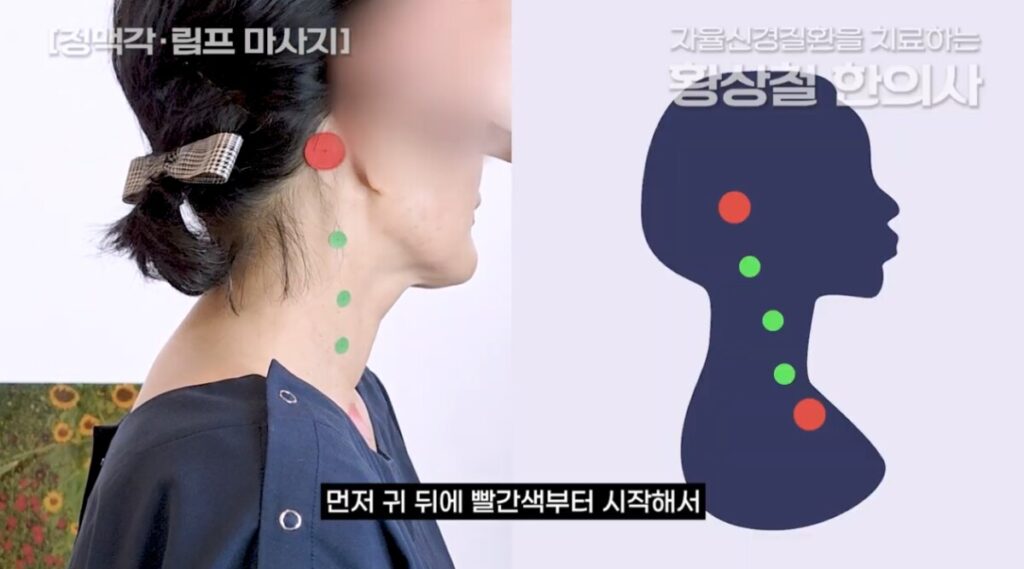
Follow along with a cervical venous angle lymphatic massage
Recent lymphatic drainage massage protocols recommend using very gentle movements along the superficial lymphatic vessels located just beneath the skin, rather than using strong pressure. In particular, the cervical venous angle is known to be an important point where systemic lymph ultimately joins the venous system, so gently directing lymph flow around the neck is often utilized.
The method is to start behind the ear and slowly pull the skin down towards the collarbone. Keep your fingers and palm pressed against the skin, but don’t press down hard, just gently move the skin, for about 5 seconds. Repeat five times on one side, then do the same on the other side.
The important point is not to press deeply into the muscle, but to move gently along the lymph flow under the skin, and pressure that is strong enough to cause pain is rather not recommended.
Lymphatic Care You Can Do at Home
- Walk 20 to 30 minutes a day
- Deep abdominal breathing
- Drink plenty of fluids
- Light stretches around the neck and collarbone
- Get regular sleep
Closing thoughts
The lymphatic system is the body’s secondary circulatory system that clears tissue fluids and wastes that the blood vessels can’t pick up, and recent research suggests that waste products from the brain are also discharged through the lymphatic system. Age, lifestyle, and stress can interfere with lymphatic circulation, but we can support lymphatic function through proper exercise, breathing, manual therapy, and autonomic nerve management. In the end, understanding lymph is not just about managing swelling, it’s about understanding the body and brain’s cleaning system.
Q.How is lymph different from blood?
A.Blood is responsible for delivering oxygen and nutrients, while lymph is responsible for collecting leftover water and waste, and immune function.
Q. Why is the cervical vein angle important?
A. The point at which lymph from the entire body finally joins the veins, and has recently been linked to the drainage of brain waste.
Q. Can lymphatic massage help with brain health?
A. Some studies have reported a link between the lymphatic system and brain waste removal. However, further research is needed on its effectiveness in treating the disease and it is important to approach it in conjunction with a proper lifestyle.