


Table of Contents
🧍♀️ BWA Body Composition Analysis – a diet diagnostic that looks at “cellular health” not weight
hello. I’m Dr. Sangchul Hwang, who studies and treats autonomic nerves. In my clinic, I often hear patients say. “I’ve been feeling swollen lately, and I’m tired after going to bed and waking up.” “I’m exercising and eating right, but I can’t seem to lose weight.” “I’ve lost weight, but I feel like I’m losing muscle and have no energy.” In these cases, I recommend a BWA body composition analysis test. This test doesn’t just look at body fat or weight, it looks at your body’s water, cellular, muscle, and metabolic status to help you get your diet on the right track.

What does the BWA check for?
BWA stands for Body Water Analyzer, a precision body composition test that analyzes not only your body fat and muscle mass, but also your hydration status, cellular health, and extracellular water to body weight ratio (ECW/TBW). It’s a great way to see what’s really going on inside your body, rather than just your weight and body fat percentage on the outside. It can be a great way to reevaluate your direction, especially if you’ve been saying things like, “I’m losing weight, but I feel heavy and bloated,” or “I’m stuck in a diet plateau.”
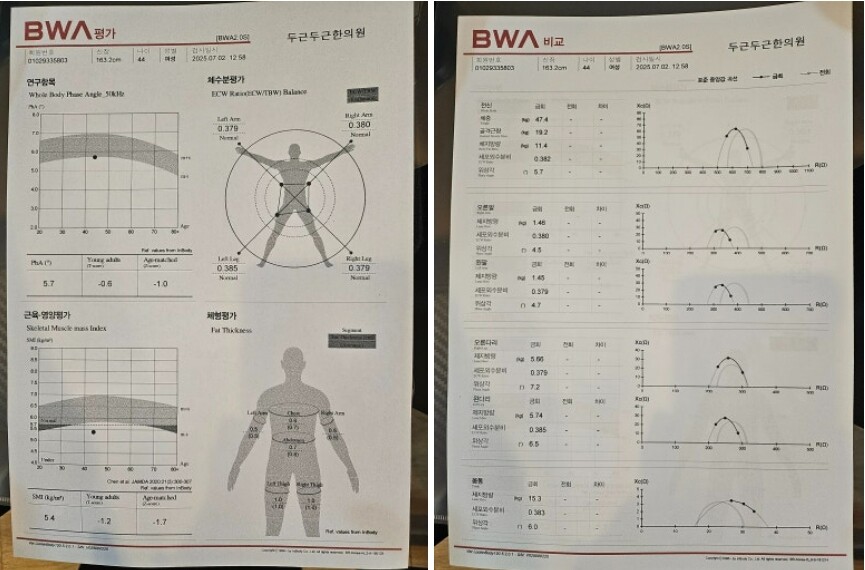
BWA checks work like this
The test is painless and simple and takes about 2-3 minutes. While you lie in bed, soft electrodes are attached to your hands and feet, and a very small current is passed through them to measure your body composition. The resistance the current encounters as it passes through water, muscle, fat, and cell membranes is analyzed to determine Total body water and intracellular and extracellular water, muscle mass and body fat by region, phase angle, an indicator of cellular health, and ECW/TBW ratio, a measure of swelling. After the test, you’ll receive your results immediately and I’ll interpret them for you based on my clinical experience.
Especially recommended for these people
If you’re not losing weight despite exercise, have frequent recurring episodes of swelling and heaviness, feel like you’re losing muscle or have decreased stamina, experience prolonged diet plateaus, or are always tired and slow to recover, a BWA test may be a good idea to determine the cause. These symptoms are often related to poor cellular function or water imbalance, not just weight fluctuations.
Losing body fat, are you on the right track?
One of the most common problems in the dieting process is the “muscle before fat” loss pattern, which is when you lose weight but your basal metabolism drops and you are prone to fatigue, coldness, swelling, and diet plateaus. The BWA test shows changes in body fat percentage, muscle mass, and basal metabolism by body part and body type, allowing you to objectively determine whether you are muscular or fatty, where fat is concentrated, and where changes will occur when you lose weight. The key to healthy weight loss is to make sure you’re maintaining muscle as you lose weight.

If you’re constantly puffy and tired – it could be a sign of increased extracellular fluid
Swelling, heaviness, fatigue, and weight stagnation are often associated with “increased extracellular water weight” (ECW), which is the excessive accumulation of water in the space outside of cells, rather than simple constitutional issues. Your body needs enough water to stay inside your cells (ICW) for energy production and repair. However, stress, inflammation, lack of sleep, crash dieting, and excessive salt intake can cause water to move out of the cells (ECW), resulting in swelling, fatigue, delayed recovery, and weight stagnation. In general, an ECW/TBW ratio of 0.38 or higher should be considered along with inflammatory changes, poor circulation, and possible water metabolism abnormalities.
Indicator of cell health – Phase Angle
Phase angle is a bioelectrical indicator of how robust and functionally active a cell membrane is. When an electric current passes through a cell membrane, healthy cells exhibit greater resistance and a higher phase angle, while damaged or aging cells exhibit a lower phase angle. A higher phase angle indicates a good resilience, metabolism, and fitness foundation, while a lower phase angle may indicate decreased cellular function, accumulated fatigue, and possible immune compromise. The general interpretation is as follows: 6.0 or higher indicates very healthy cells (athlete level), 5.0-6.0 is in the healthy adult category, 4.0-5.0 is borderline and should be considered for possible metabolic and immune decline, and 4.0 or lower should be evaluated for a combination of cellular decline, poor recovery, and risk of chronic fatigue. Interpretation may vary based on age, gender, and fitness, but anything below 4 should be considered for improvement strategies.

Approaches to increasing phase angle
According to Chinese medicine, “a state of full blood and smooth water metabolism” is closely linked to cellular repair. To restore phase angle, the approach is to support cellular function with a balanced protein intake, adequate sleep and recovery time, a diet that focuses on muscle maintenance rather than excessive weight loss, proper hydration and electrolyte balance, and Chinese herbal treatments (acupuncture, moxibustion, and supplements) tailored to your constitution.
The Cell-Centered Diet with Chinese Medicine
In our practice, we use your BWA results to design a cellular health-enhancing herbal medicine, swelling-reducing acupuncture/acupuncture treatment, muscle-maintaining weight loss program, and anti-cellular aging diet and lifestyle coaching tailored to your constitution. The key is not just weight loss, but “the process of transforming the body into a body with healthy functioning cells.”

A healthy diet is not a ‘number’, it’s a ‘cellular power’
Feeling bloated, tired, and unable to lose weight often starts with your cellular health and water balance, not your weight. Find out exactly how your body is doing right now with a BWA body composition analysis. We’ll interpret your results with you and guide you toward the best treatment and care.