

Table of Contents
hello. I’m Dr. Sangchul Hwang, who studies and treats autonomic nerves.
Do I really need to do a body shape examination? One of the things I often hear in the clinic is, “My posture is wrong, but I don’t know exactly where the problem is,” “When I stand for a long time, the soles of my feet get stiff and pull up to my waist,” or “Imaging tests show no abnormalities, but the pain continues.”
In such cases, a precise body type diagnosis that looks at body alignment, weight distribution, joint movement, and foot arch structure should be prioritized over a simple imaging test. We systematically evaluate the structural causes of pain through X-Body body type analysis, ROM range of motion test, MOIRE muscle asymmetry analysis, and ARCH foot arch test.
Why Body Type Testing and Body Analysis Matters
Small misalignments in body shape can lead to full-body pain, fatigue, and misalignment over time. In clinical practice, they are often associated with the following issues
Herniated Disc and Chronic Low Back Pain
Turtle neck, straight neck, and cervical spine imbalances
Pelvic tilt and hip pain
Leg length discrepancies and side-to-side weight imbalance
Plantar pain and plantar fasciitis
O-leg, X-leg, and knee joint pain
Lower extremity swelling and circulation problems
Because these changes often occur slowly while invisible to the eye, precise body shape analysis can help with early diagnosis.

XBody Body Shape Analysis
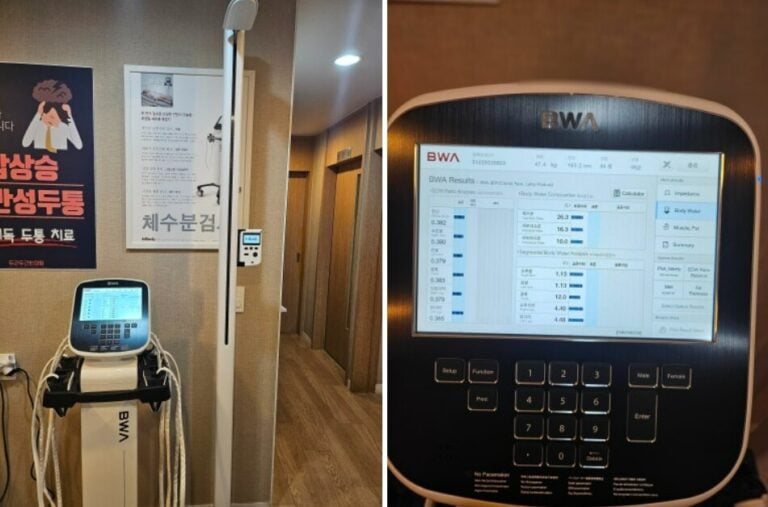
XBody is a full-body analysis device that quantifies body shape and alignment just by standing. The examiner simply stands comfortably in the correct position, and the system automatically calculates alignment.
You can quantitatively verify the following items
Side-to-side height difference in the shoulders and pelvis
Degree of spinal curvature and torsion
Left and right center of gravity distribution
Leg alignment and weight bearing patterns
Leg length imbalance
It’s great to be able to see how you’re doing with numbers and data, rather than how your body feels.

ROM joint range of motion tests
A ROM test is a precise measurement of the range of motion of major joints, such as the neck, shoulders, hips, and knees.
It moves less in certain directions or
movement outside of the normal range.
Abnormalities can be detected before they become painful. These results are important for guiding future corrective exercises and chiropractic treatment.

MOIRE Muscle Asymmetry Visualization Test
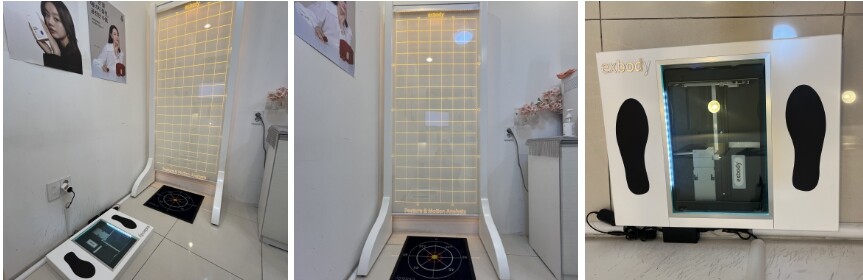
The MOIRE test analyzes the changes in your body’s taut muscle pattern to visualize side-to-side muscle asymmetry and spinal curvature.
Direction of Muscle Tension
Where the load is applied
How the distortion progresses
These factors can be recorded as images, making it easier for patients to understand their body shape changes.
ARCH Foot arch exam
Body shape starts at the feet. When the arch of the foot collapses, it sequentially affects the knee, pelvis, and spine. The ARCH test analyzes plantar load distribution, arch height, and side-to-side balance in a static state.
Whether you have flat feet or high arches
Areas of load concentration
Left and right foot support patterns
Predisposition to plantar fasciitis
In addition to plantar pain, it is often found to be the cause of knee and hip pain.

Custom arch correction orthotics prescription
Based on the results of your arch exam, we’ll customize a functional orthotic insole for you. They’re not just cushioned insoles, but functional orthotics that help distribute weight and stabilize the arch.
Reduce plantar pain
Inhibit arch collapse progression
Reduces knee and pelvic strain
Aids in body contouring
This is especially useful if you work on your feet for long periods of time or do a lot of walking.
Recommended targets include
If you have plantar fasciitis symptoms
The bottoms of your feet or knees hurt after standing for a long time
Wearing out one side of your shoes
You have numbness and swelling in your legs
You have been recommended orthotics by an orthopedic surgeon.

Post-test care is linked like this
Testing is the starting point for treatment. Based on the results, we will combine the following treatments
Body Centered Pranayama
ROM Correction Exercise Program
Balance management to improve muscle asymmetry
Prescription of functional orthotics to stabilize the arch of the foot
Acupuncture, medicinal acupuncture, and manual therapy as needed
When posture collapses and the arch of the foot collapses, the knee, pelvis, spine, and shoulders that rest on top of it will sequentially wobble. Understanding the structure and finding the cause is the key to treatment.

Read body types numerically, explain causes structurally
X-Body, ROM, MOIRE, and ARCH tests provide a visual and numerical interpretation of body shape, foot structure, joint mobility, and muscle patterns. When you know exactly what’s causing your pain, the direction of treatment becomes much clearer.
If you’re experiencing any uncomfortable symptoms, we encourage you to get yourself checked out. If you have any questions, feel free to leave them in the comments. We’ll do our best to answer them.