

hello.
I’m Dr. Sangchul Hwang, an autonomic nervous system researcher and therapist.
People who have had all their tests done and everything is fine, but they are having a hard time with the sound in their ears,
I see a lot of people in my clinic for tinnitus.
I’ve heard that the audiogram is normal, the MRI is normal, and the blood tests are fine.
How frustrating it must be to have a constant ringing in your ears.
Many people say in this situation
“Dr. Director, if there’s nothing wrong with my ears, why do they keep ringing?”
The reason is simpler than you might think.
Tinnitus is not just a problem with your ears, it’ s a problem with your brain and autonomic nerves.
Hair cell damage and the onset of tinnitus
The hearing organ inside your ear is home to tiny cells called hair cells.
These cells are responsible for converting vibrations in the air into electrical signals that are sent to the brain.
It’s thanks to these hair cells that we can hear sounds.
The problem is that once these hair cells are damaged, they rarely regenerate.
Common causes of hair cell damage include
Constant noise exposure, chronic stress, poor blood flow, and certain medications,
sensory nerve weakness due to aging.
When these cells don’t work properly, the brain produces “abnormal signals” instead of normal sounds.
The beeps, buzzes, and cicadas we hear are tinnitus.
Will my tinnitus never fully recover?
But in clinical practice, we often see something surprising.
We’ve had people with reduced or nearly eliminated tinnitus, even though the hair cells themselves have not recovered.
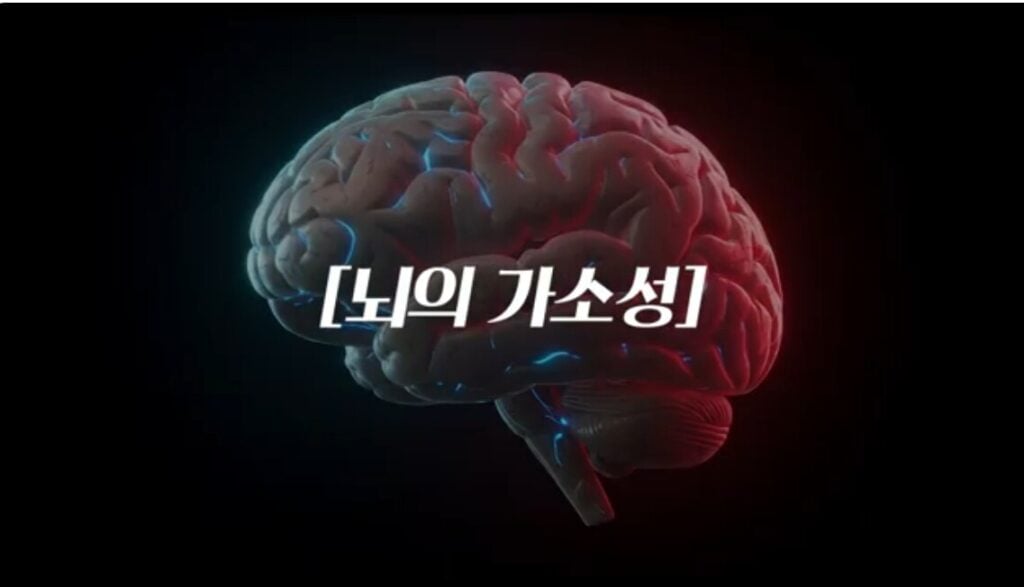
The reason for this is the brain’s plasticity.
The brain has the ability to rewire itself so that when one part of the brain is weakened, another part can take over
to reorganize its circuits so that other parts can take over.
This ability to bypass damaged areas and create new pathways is brain plasticity.
That’s why treating tinnitus involves treating the brain, not just the ears.
The deep connection between tinnitus and the autonomic nervous system
If you look at the tinnitus patients I see in my office, they almost always have one thing in common
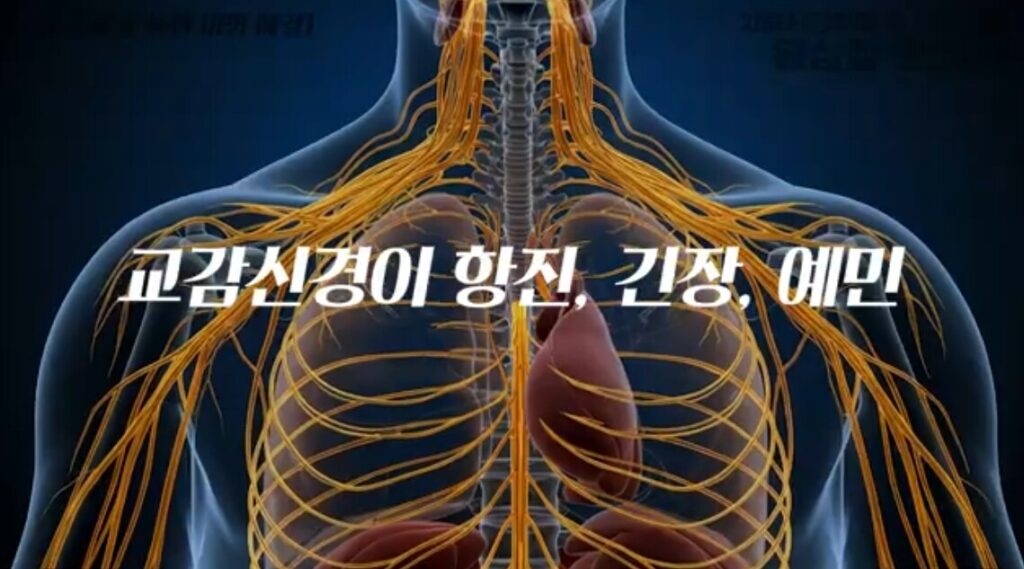
overactive sympathetic nerves.
When stress, overwork, insomnia, and chronic fatigue build up, the body perceives a crisis and keeps the sympathetic nervous system activated.
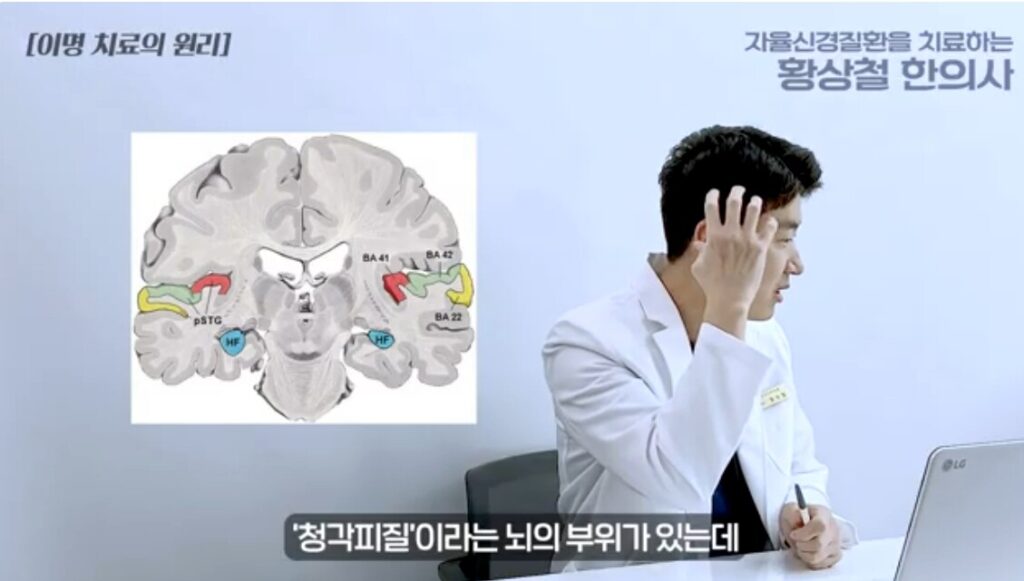
The brain’s nervous system, including the auditory cortex, becomes overactive, and tinnitus becomes more pronounced.
In particular, around the auditory cortex are the amygdala, pituitary gland, and other structures that regulate emotions and hormones,
and autonomic nervous system are located in close proximity.
This is why tinnitus often worsens as anxiety, tension, and fatigue increase.
The vagus nerve, which connects the ear to the brain
The vagus nerve is an essential part of tinnitus treatment.
The vagus nerve is a key pillar of the autonomic nervous system that controls the balance of sympathetic and parasympathetic nerves.
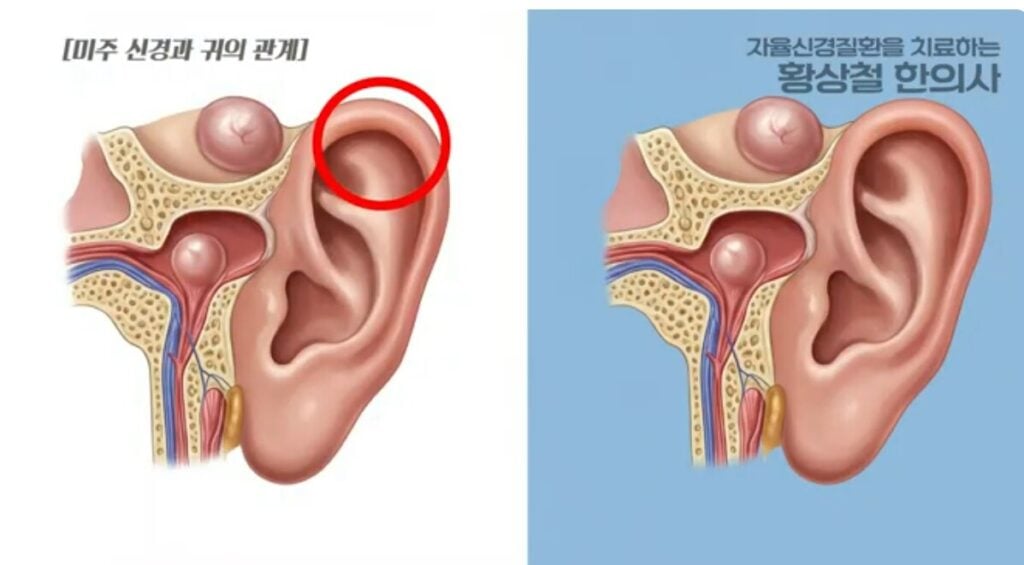
There are important areas around the ear that are connected to this vagus nerve.
Stimulating these areas can help relieve tension tinnitus as the balance of autonomic nerves is gradually restored.
More recently, studies have shown that certain points in the auricular region and next to the ear are close to the vagus nerve.
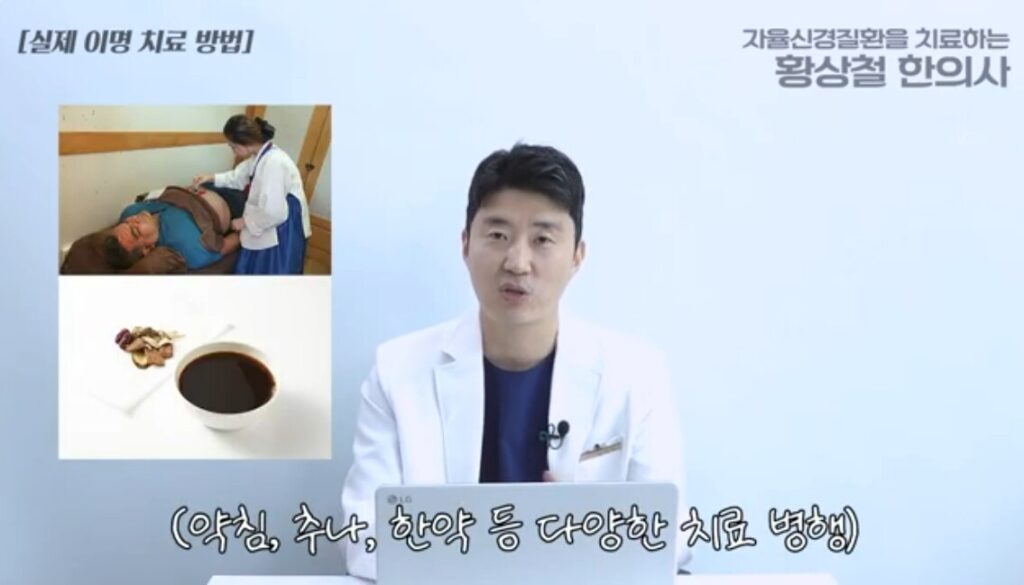
Chinese medicine has long used stimulation of this area to treat tinnitus, insomnia, anxiety, and stress.
Acupuncture points on the ear, with neuroanatomical significance
────────────────────
There are many acupuncture points on the ear, one of which is known as the newspaper point.
It is known to calm the mind and regulate the heart rate and autonomic nervous system.
With the discovery that this acupuncture point is very close to a branch of the vagus nerve
the rationale for TCM tinnitus treatment is becoming clearer.
If your ear feels hard or painful when you press on it
it could be a sign of overactive nerves or stagnant blood flow in the area.
If you have deep wrinkles in your earlobes or your ears appear cloudy in color
may be associated with poor cardiovascular function or cerebral blood flow.
In other words, the ear is more than just a hearing organ.
they are an important window into the overall health of your brain and body.

Your ears are a mirror of your body
Your ears are more than just organs that hear sounds.
The color, firmness, and pain response of your ears can tell you a lot about your blood flow and nerve tone.
If your ear is hard or painful when pressed, it could be a sign that the nerves in the area are overactive.
If the color of your ears appears dark and cloudy, it could also indicate poor circulation and oxygenation.
If you have deep wrinkles in your earlobes, you may also want to consider the connection to your cardiovascular system and blood flow to the brain.
Your ears are silent, but they’re relaying your body’s signals pretty accurately.
The Key to Tinnitus Treatment
is not just about getting rid of the sound
The key to treating tinnitus isn’t just about getting rid of the sound.
The goal is to restore balance to the brain and autonomic nerves, regulate blood flow and tension, and restore balance to the entire body.
Tinnitus rarely gets better by treating the ears alone.
It takes a combination of brain, nerve, circulation, stress, and sleep to stabilize symptoms.
Final thoughts
If you’ve been suffering from tinnitus for a long time, you might want to take a look at this.
How tense my body is right now,
whether you’re getting enough sleep,
stress and fatigue are building up.
Tinnitus is not just a problem with your ears.
It’s a complex condition that involves the brain, autonomic nerves, circulation, and mind.
If you’re still woken up at night by sounds,
don’t suffer alone, listen to your body’s signals.
In the next article, we’ll give you practical tips on how to manage your tinnitus and
and how to treat it according to your constitution.
If you have any questions, feel free to leave them in the comments.
Together, we can take the road to recovery slowly and safely.