

I took it because it looked good…. But did it make your cystitis worse?
The real reasons why interstitial cystitis worsens are as follows
Hello, I am Dr. Sang-Chul Hwang ().
I am Hwang Sang-chul (
), a Korean physician who studies and treats the autonomic, bladder and pelvic nerves.
Cystitis and lack of exercise,
Tests show “nothing abnormal.”
She takes antibiotics, but the bladder infection comes back.
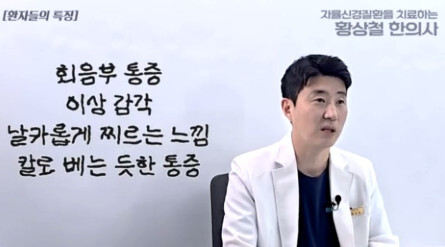
You must be tired.
I have seen many of these people.
Many of them are missing an important reason.
I’m home!
Not all cystitis symptoms begin in the bladder.
in the same way as
Please take your time from now on,
But, in-depth information that you really need.
Information that patients really need to know.
1. “Why does my bladder hurt when it is normal?”
– Symptoms of cystitis, more than 70% of which are due to non-infectious causes.
Bladder pain = cystitis
We tend to associate these two.
In fact, the same symptoms can be caused by a variety of reasons, as shown below.
- Bladder mucosa damage (interstitial cystitis)
- Pelvic floor muscle stiffness
- Nerve compression in the pubic region
- Back – sacroiliac joint neuropathy
- Overactivity of the autonomic nervous system
- Bowel function problems (constipation – irritable bowel)
- Stress – Perfectionist tendencies
- Specific Foods – Hormonal Changes

Interstitial cystitis (IC) in particular is not a bacterial infection
It is not a bacterial infection, but a micro-damage of the bladder mucosa + nerve irritation.
Antibiotics will never cure it.
Therefore, it is not surprising that the test results were “normal.”
Autonomic nervous system and bladder
– Scientific reasons for bladder sensitivity under stress.
The bladder is strongly controlled bythe sympathetic and parasympathetic nerves.
- Sympathetic nerve overactivity → increased bladder muscle tone → numbness, irritation
- Parasympathetic imbalance → inability to control bladder contractions → frequent urination and pain
People with the following personality patterns are particularly susceptible to interstitial cystitis
Interstitial cystitis.
- Perfectionism – Sensitivity (Antisocial Model)
- Stress due to lack of water
- A little pressure can stiffen the body.
- Lack of patience
Conversely, the square pattern is problematic.
- Liver Fever
- Stagnant lymphatic bleeding in the lower abdomen
- Upper heat + lower gas
- Abdomen and pelvis rigid under pressure
In other words
Body constitution + autonomic nervous system + bladder mucosa disorder
When these three work together
the pain lasts longer and is harder to heal.
3. Neuralgia of the pubic region – a condition often confused with interstitial cystitis
Pattern of “Worse when sitting, pain but urination is normal.
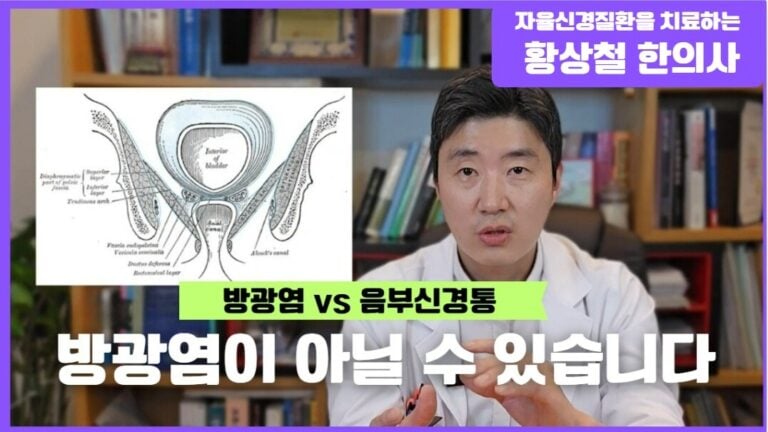
There is a narrow nerve pathway in the pelvis called the Alcock tunnel.
The pudendal nerve passes through here.
When compressed by muscles, it can be mistaken for pain in the bladder area.
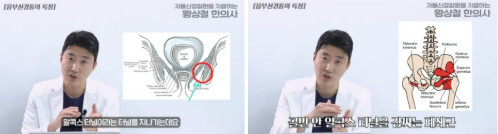
Characteristics of pubic symphysis
- Burning sensation around the perineum, vagina, penis, or anus
- Sedentary behavior may exacerbate symptoms.
- Relief by walking or lying down
- Urinalysis is normal.
- Frequent urination – decreased urination
- Chronic tension of pelvic floor muscles
If these characteristics are not noticed
can be misdiagnosed as cystitis for years.
Taking antibiotics for years

4. Bladder pain due to herniated disc – stenosis
– Lumbar nerves 2-4 (L2-L4) are connected to the bladder.
The nerves that control the bladder come from the lumbar and sacral nerves (S2-S4).
Lumbar and sacral nerves (S2-S4).
Therefore, suffering from this symptom leads to bladder pain.
- slipped disk
- spinal canal stenosis
- Sacroiliac joint (SI joint) imbalance
- Iliopsoas muscle – gluteal strain
- sedentary work
In this case, the bladder is intact, but
The nerves are overexcited and pain occurs in the bladder area.
So, if you are one of these people.
If you treat your back, your bladder symptoms will be less severe.
The number one hidden cause that aggravates interstitial cystitis is constipation.
– Increased bowel pressure → increased bladder pressure → increased nerve irritation
Constipation causes an increase in abdominal pressure.
The increased abdominal pressure puts pressure on the bladder, which is directly below.
The bladder wall and nerves are irritated.
In particular, IC patients
have a thin bladder mucosa.
even the smallest irritation can cause severe pain.
Therefore, in the treatment of constipation
Treatment of constipation is almost mandatory.
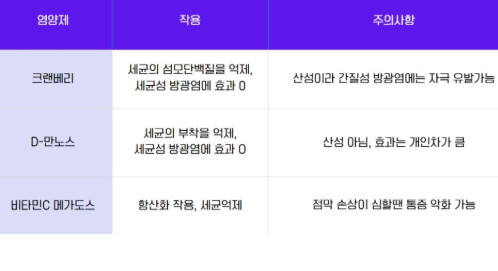
Cranberry, D-mannose, vitamin C megadoses
– When things go well and when they go badly
Many patients
“It’s good for the bladder: ……”
“I eat it because they say it’s good for Europe: ・・・・・・”
However.
But we need the right information.
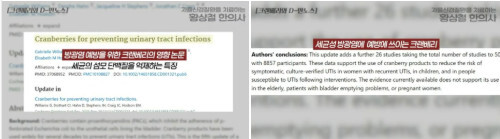
When it helps
- Prevention of recurrence of bacterial cystitis
- Retest for E. coli in urine
- Recurrent infections due to lowered immunity
If the situation worsens
- Interstitial cystitis (IC)
- Injury to bladder mucosa
- Sensitive to changes in bladder acidity
- If caused by pubic neuralgia
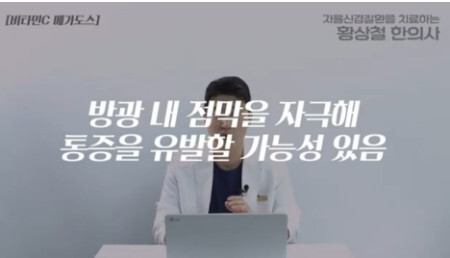
In particular, large amounts of vitamin C
increases the acidity of the bladder and
causes severe pain in patients with damaged bladder mucosa.
in other words
Bacterial → Some improvement /
Neurogenic – Mucous membrane damage type → Worse
Just keeping these principles in mind can be very beneficial.
7. Interstitial cystitis and food sensitivities
– Why spicy food causes pain (neurological cause)
Spicy food is not just bad for you because it is stimulating.
Capsaicin strongly activates the TRPV1 pain receptor,
This receptor is also present in the bladder mucosa.

therefore
- capsaicin
- acid(ic) foods
- soda drink
- caffeine
- chocolate
- Watermelon – beans (personal preference)
These foods are known to
Stimulate pain receptors in the bladder mucosa
Stimulate pain receptors in the bladder mucosa, causing a rapid increase in pain.
However, the opposite is true.
Protein (meat) does not stimulate these pain receptors, so meat rarely aggravates pain.
Meat rarely aggravates pain.
8. Exercise – Why “good exercise” is actually poison
– Interpretation based on pelvic floor muscle tone
Overactivity of the pelvic floor muscles is a common symptom in IC patients.
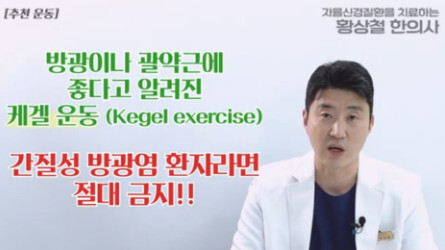
However, most Kegel exercises and core exercises
contract the pelvic floor muscles and
aggravate the pain.
🚫 Exercises to avoid
- Kegel exercises (absolutely not)
- Pilates core strengthening exercises
- Increased abdominal pressure
- Bend your knees and raise your legs.
- Exercises Focusing on Contraction in Machine Pilates
- long-distance cycling
Recommended safe training
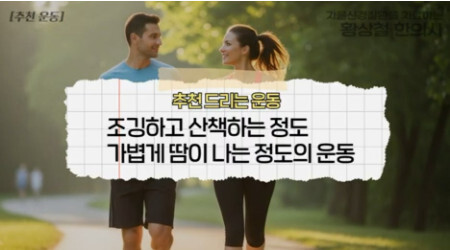
- 20-40 minutes of brisk walking
- Jogging without pain
- Lengthening (stretching) yoga asanas
- Pelvic correction stretch
- Heating and Stretching
🛑 Lifestyle habits to avoid
- Lamb thigh
- leg rope
- Sitting on the toilet for long periods of time.
- Edge sitting (hips forward)
Many people feel that this change alone will eliminate pain.
9. Why does interstitial cystitis “flare up”?
– It is a disorder of the bladder, nerves, autonomic nervous system, pelvic muscles and body.
Interstitial cystitis consists of the following five symptoms
- Microdamage to bladder mucosa
- Hypersensitive nerves
- Excessive tension in pelvic floor muscles
- autonomic ataxia
- Physical characteristics (yang-yin characteristics)
Treating only one or the other will never cure the disease.
So it is obvious that after a slight improvement in symptoms, they recur.
They recur.

10. “The right medicine for the right cause.”
Many patients ask me.
“Director. Do you think it can be cured?”
Yes, we can.
But only if you find the exact cause.
What is interstitial cystitis?
Bladder – Nervous System – Muscle – Autonomic Nervous System – Somatic
Bladder, nervous system, autonomic nervous system, somatic.
Pain can easily ruin your life and
It can be mentally draining,
Never suffer alone.
Things will always get better if you do things the right way.
Have a question or need help?
Please leave us a message.
We will do our best.
![[ Pudendal Neuralgia ] I thought it was prostatitis… What if it doesn’t get better even after taking antibiotics?](https://dkdkclinic.com/wp-content/uploads/2026/07/20260728_165654-768x441.jpg)