

Table of Contents
hello. I’m Dr. Sangchul Hwang, who studies and treats autonomic nerves.Are you suffering from a feeling of loose stools that doesn’t relieve you and makes you want to go to the bathroom, or a heavy, stabbing pain inside your anus when you sit on a chair? If you think it’s hemorrhoids and applying ointments doesn’t help, there may be a hidden cause called ‘anal levator ani syndrome’ that we will explain today.
1. What is anal sphincter syndrome?
Anorectalgia is a functional paincondition in which pain or discomfort deep in the anus persists despite the absence of any specific wound, inflammation, or cancer. Simply put, it’s an overactive muscle or nerve surrounding the anus.
- Prevalence: Common enough that 10-15% of adults will experience it at least once in their lifetime.
- Vulnerable people: people over 40, people with sedentary jobs, and people with high levels of stress.
2. Anatomy and role of the anal sphincter
The ‘anal sphincter’ is not one muscle, but three muscle layers that work together organically.
- Puborectalis muscle: Located at the bottom and controls stool. When strained, it tightens the opening, causing loose stools.
- Pubococcygeal muscle: Located in the middle layer and controls urination, genitals, and perineal sensation. Problems can be accompanied by urinary problems.
- Iliacococcygeal muscle: The widest and highest, it acts as a base camp to support the pelvis and tailbone.
3. the importance of stress and bowel habits
Why does my anus hurt when I’m stressed? When your body is stressed, your pelvic muscles tense up, just as your neck tightens.
- Sympathetic hyperactivity: When stress is prolonged, the sympathetic nerves become sensitive and blood and lymphatic circulation decreases, resulting in pain.
- Poor bowel habits: Excessive straining on the toilet can cause the anal sphincter to contract further, making the pain worse. If you can’t get a bowel movement out, it’s better to give up and move on to the next opportunity.
4. Proper bowel position: “Use a foot rest”
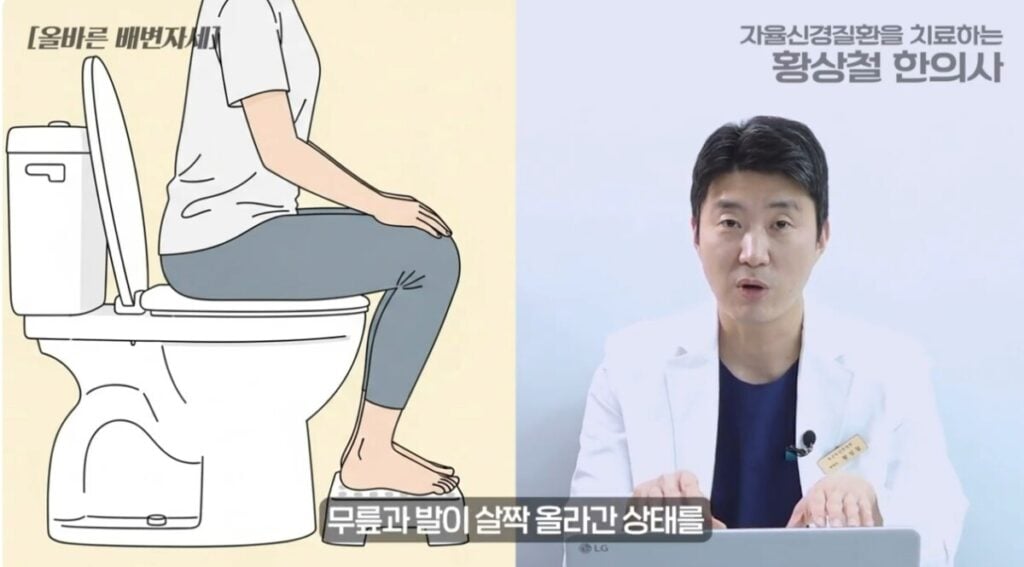
The best position to defecate is squatting. However, it can be hard on your knees and lower back, so we recommend placing a footrest under the toilet seat. A slightly elevated knee position also allows the angle of your rectum to open up, allowing you to defecate without straining your muscles.
5. How do I confirm?
The first step is to make sure you don’t have any other risk factors (cancer, fractures, hemorrhoids, etc.).
- Differential diagnosis: X-rays, MRIs, CTs, etc. to rule out temperamental issues.
- Rectal resin test: If a specialist presses on a specific point inside the anus and the pain you usually feel is strongly reproduced, you may have an anal sphincter syndrome.
Unexplained Anal Pain, You Can Fix It
Anal sphincter syndrome is more than just an anal condition; it can cause pain that radiates to the bladder, lower back, and thighs. By listening to the signals your body is sending you, and with the right habits and professional help, you can get better.
In the next installment, we’ll cover relaxation exercises and specific treatments to help with anal sphincter syndrome.