

Table of Contents
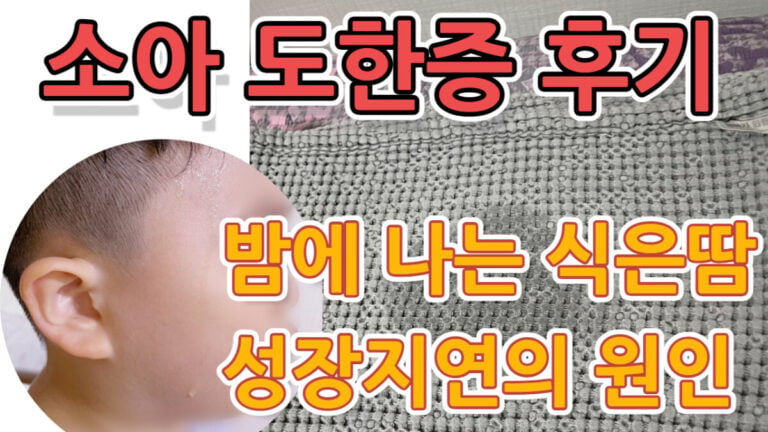
If I only sweat at night, is that still hyperhidrosis?
Hello. I am Dr. Hwang Sang-cheol, a specialist in the research and treatment of the autonomic nervous system.
When I talk with patients who come to my office with excessive sweating, I often hear this question.
“Doctor, I hardly ever sweat on my hands or feet, but I break out in cold sweats only at night. Is this also hyperhidrosis?”
Another person says, “I was definitely sleeping comfortably, but when I woke up at dawn, my blanket and pajamas were soaked through.”
“
Since there are no specific symptoms during the day and the sweating only occurs repeatedly after falling asleep, it’s hard for the person to figure out the cause, and
and it’s not uncommon for people around them to brush it off lightly, saying, “Aren’t you just naturally prone to sweating?”
However, in some cases, recurrent night sweats cannot be explained simply as a matter of constitution.
Since it could be a signal from your body, it’s important to take a closer look at your current physical condition.
What is excessive sweating?
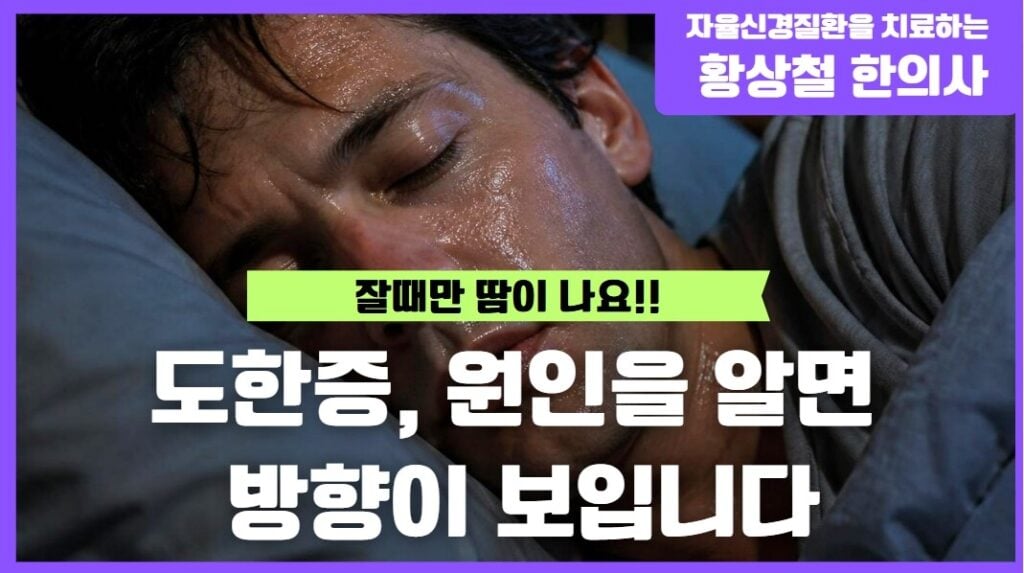
In traditional Korean medicine, the condition of sweating only while sleeping is called “daohan” (盜汗).
“Do (盜)” means “to steal.”
The name comes from the characteristic that, while sleeping, a person sweats without realizing it, only for the sweating to stop as soon as they wake up, as if nothing had happened.
This also applies to situations where you sweat so much that your pillow or clothes get wet, whether you’re sleeping at night or taking a nap during the day.
The important thing to note here is that you only sweat when you are resting comfortably without moving, and while you are asleep.
Sweating during exercise or in a hot environment is a normal response to regulate body temperature.
However, if you repeatedly sweat only at night for no apparent reason, it’s important to investigate the cause more closely.
What is the difference between “Jahan” and “Dohan”?
Many people think, “Isn’t excessive sweating always the same?” but
in traditional Korean medicine, the timing of sweating and the accompanying symptomsare considered crucial.
“Jahan” refers to a condition in which a person sweats profusely during waking hours without any specific activity,
and is often accompanied by symptoms such as easy fatigue, lack of energy, or frequent colds.
In traditional Korean medicine, this condition is described as a state in which the protective energy of the body, known as “wei qi” (衛氣), is weakened, preventing it from properly regulating the sweat pores.
In contrast, night sweats are characterized by their occurrence only while sleeping, and the sweating often stops upon waking.
Symptoms such as a burning sensation in the palms and soles, a dry mouth, and a feeling of heat in the body starting in the afternoon may also occur together; this is understood as a condition in which body fluids are deficient, causing heat to rise upward.
In actual clinical practice, it is not uncommon for internal heat and external heat to occur simultaneously.
Therefore, rather than simply focusing on whether it is day or night,
it is important to also assess sleep quality, fatigue, stress, and accompanying symptoms.
Palmar hyperhidrosis is also a type of hyperhidrosis.
When people hear the term “hyperhidrosis,” many think only of palmar and plantar hyperhidrosis.
However, hyperhidrosis is a broad term that encompasses all conditions involving excessive sweating.
It covers not only palmar-plantar hyperhidrosis but also cephalic hyperhidrosis, characterized by excessive sweating on the head and face,
sleep-related sweating (dohan), daytime sweating without a specific cause (jahwan),
and night sweats caused by hormonal changes during menopause.
In addition, there are cases—such as hyperthyroidism—where an increased metabolic rate leads to excessive sweating throughout the body, and
and there are also cases where sweating increases due to the effects of certain medications or chronic diseases.
In other words, even if the symptom—excessive sweating—is the same, the underlying causes can vary greatly.
That’s why, during a consultation, we don’t just ask whether you sweat only at night.
Do you sweat during the day? Where do you sweat the most?
whether you have menopausal symptoms, thyroid disorders, weight changes, or fever,
to comprehensively assess your current sweating patterns.
Why Menopause and Hot Flashes Occur Together
When discussing night sweats, menopause is a topic that cannot be overlooked.
In fact, in my practice, I frequently see patients who have trouble sleeping every night due to night sweats after menopause.
Estrogen, a female hormone, plays a key role in maintaining a stable body temperature,
but as hormonal changes occur with the onset of menopause, the body’s ability to regulate body temperature may become more sensitive than before.
As a result, you may experience recurring episodes of facial flushing or wake up in the middle of the night with sudden cold sweats.
In traditional Korean medicine, these changes are explained by the concept of “yin deficiency heat” (陰虛熱).
It is a condition in which the body’s cooling fluids become deficient, causing an imbalance that allows heat to rise relatively upward.
Of course, these two concepts are explained within different medical systems, but
in actual clinical practice, they often manifest in similar ways.
Common Presentations of Hyperhidrosis Seen in the Clinic
A woman in her late 50s began waking up several times a night as she went through menopause.
I would sweat so much that my pajamas would get wet, and by morning, I felt heavy and tired.
As we talked in more detail, she mentioned that the palms of her hands and soles of her feet felt hot, she experienced a flushing sensation in her face every afternoon, and
and she was no longer sleeping as soundly as she used to.
Another office worker in their 40s began experiencing night sweats only at night following a period of excessive work and stress.
Although they were fine during the day, their night sweats seemed to worsen as their stress persisted and the quality of their sleep declined.
Even for the same condition—excessive sweating—the underlying causes and physical condition can vary from person to person.
Therefore, the process of identifying the specific cause relevant to your own body is of the utmost importance.
Let’s put this into practice together in our daily lives.
When managing night sweats, it can also be helpful to take a closer look at your lifestyle habits.
Since spicy foods, caffeine, and alcohol before bedtime can raise your body temperature and make nighttime hot flashes worse,
it’s best to limit these as much as possible in the evening.
Keep your bedroom moderately cool so it doesn’t get too hot, and
and using bedding that wicks away sweat effectively can also help.
If you’ve been overworking, it’s important to give your body enough time to recover.
Also, for those experiencing ongoing stress,
that gradually relieve physical and mental tension, such as a light walk or breathing exercises.
Sweating at night is also an important signal from your body.
Night sweats that recur every night are a symptom that is difficult to explain to others.
As a result, there are quite a few people who simply put up with it for a long time, thinking, “I guess I’m just the type who sweats a lot.”
However, recurring night sweats can reduce sleep quality and
can lead to fatigue and difficulty concentrating the next day, and can have a significant impact on your quality of life.
The key isnot simply to reduce sweating, but to work together to identify why these changes are occurring.
The causes can vary from person to person—whether it’s due to menopause, stress and changes in the autonomic nervous system, or a decline in physical fitness.
If, while reading this post today, you felt it resonated with your own story, I hope you won’t have to endure it alone for too long.
Your body doesn’t send signals for no reason.
If you understand those signals and gradually restore your body’s balance, you’ll be able to enjoy much more restful nights than you do now.
I hope this post offers some comfort and help to those of you struggling with night sweats.
As I always say, our bodies are constantly sending us signals.
Rather than ignoring those signals, simply taking the time to listen to them can be the first step toward recovery.
Please don’t struggle with this alone; let’s examine your current physical condition together and find the path that’s right for you.
I sincerely hope you’ll be able to regain restful nights and a healthy daily life.