


Table of Contents
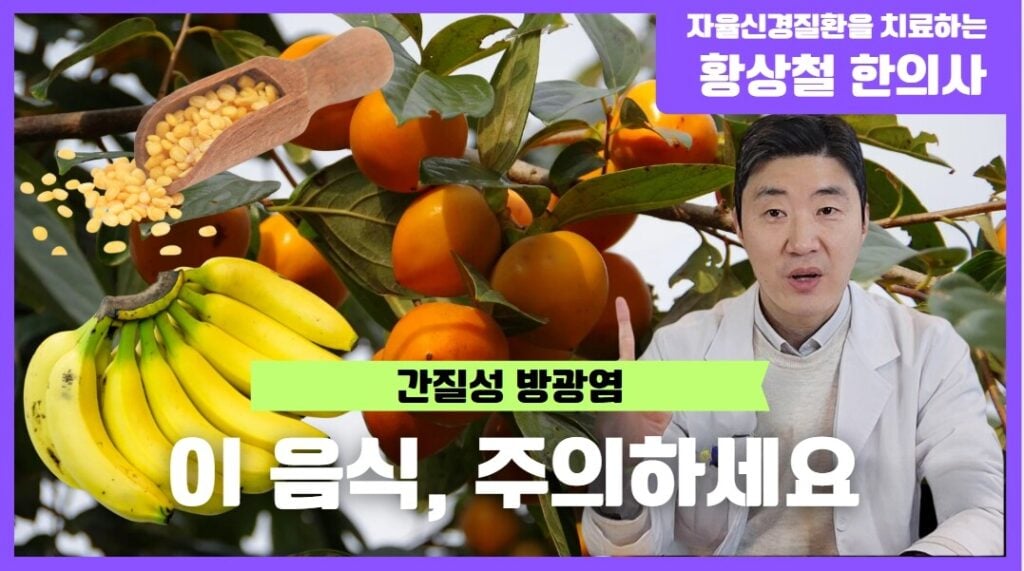
hello. I’m Dr. Sangchul Hwang, a urologist who studies and treats the autonomic nervous system. There are so many people who are careful about food because of cystitis. Especially if you have interstitial cystitis, you are often told to avoid spicy or irritating foods. However, in my clinical practice, I often hear stories like this: I didn’t eat irritating foods, but my symptoms suddenly got worse. So, when I listen to their diets, there is a common thread. They’ve been eating things like persimmons, bananas, chestnuts, and beans. On the surface, they’re not irritating foods, and they’re supposed to be healthy. But why can these foods cause problems for people with interstitial cystitis? Today, I’ll explain why these foods can make symptoms worse for people with interstitial cystitis, based on real-world clinical experience and research.
Two ingredients that are problematic for people with interstitial cystitis
Foods like persimmons, bananas, chestnuts, and beans have two ingredients in common. These are potassium and tannins, both of which can irritate the bladder lining in people with interstitial cystitis.
Why Potassium Worsens Interstitial Cystitis Symptoms
Potassium is generally recognized as a healthy mineral. It plays a role in regulating blood pressure, maintaining nerve function, and controlling muscle contractions, among other things. But it can be problematic for people with interstitial cystitis because the bladder’s mucosal lining is damaged. A normal bladder has a protective lining called the GAG layer. However, in people with interstitial cystitis, this GAG layer is often damaged or thinned out, which can lead to components in the urine coming into direct contact with the bladder mucosa. Because potassium is an electrolyte, direct contact with the bladder mucosa in this condition can irritate nerve endings, resulting in symptoms such as pain, burning, urgency, and urge urination. In other words, it’s not that potassium itself is toxic, but rather that in a bladder with a weakened barrier, potassium can be an irritant.
Potassium-stimulated response confirmed in the literature
This has been confirmed in real-world studies. A 2001 study published in the Korean Journal of Continence and Urinary Incontinence compared the responses of patients with interstitial cystitis to a saline and high-potassium solution injected into the bladder. The results showed that patients with interstitial cystitis had a much stronger pain response to the high-potassium solution. Researchers explain that because people with interstitial cystitis have a compromised bladder lining, ions such as potassium in their urine can irritate bladder nerves. This can lead to foods that you might eat innocuously worsening your symptoms. Common foods that are high in potassium include bananas, lentils, potatoes, sweet potatoes, tomatoes, and kiwi. Repeated consumption of these foods can lead to high levels of potassium in the urine, which can irritate the sensitive bladder lining.
The second problem, tannins
The second potentially problematic ingredient is tannins. Tannins are found in persimmons, chestnuts, unripe bananas, lentil shells, and more, and are also found in black and green tea. Tannins are characterized by their astringent properties. In layman’s terms, it shrinks and hardens mucous membranes, or in other words, it makes them shrivel up. This is why we get constipated when we eat a lot of persimmons: the tannins shrink the intestinal mucosa and strip it of water.
How Tannins Affect the Bladder Mucosa
A study published in 2020 confirmed that tannins bind strongly to mucosal proteins and change their surface structure. A similar reaction may occur in the bladder mucosa. When tannins come into contact with the bladder mucosa, which is already sensitive due to inflammation, it can cause reactions such as mucosal contraction, irritation, and dryness. The result is a more sensitive bladder, which can worsen symptoms. Persimmons in particular are very high in tannins. Chestnuts and lentil shells also contain a fair amount of tannins. These ingredients can work in combination to worsen bladder symptoms.
So should you avoid these foods completely?
This doesn’t mean you have to stop eating these foods altogether – everyone’s body is different and reacts differently to food. The best thing to do is to keep a food diary and note which foods make your symptoms worse, so you can find the foods that don’t work for you – your triggers. If you find that your symptoms flare up frequently and you’re not sure why, foods like persimmons, bananas, lentils, and chestnuts should be suspect. You may want to try temporarily eliminating them for two to three weeks to see if your symptoms improve, and then reintroduce them in small amounts to see how you react.
The Most Important Things in Interstitial Cystitis Food Management
Interstitial cystitis is not caused by one specific food alone, but rather a combination of bladder mucosal conditions, autonomic balance, and inflammation. This is why it’s important to take the time to observe which foods your body is sensitive to, rather than eliminating them outright.
Finalize
What’s good for you isn’t always good for everyone, especially if you have interstitial cystitis, a condition where your bladder is sensitive, and the foods you eat without thinking about it can make your symptoms worse. If you’re experiencing recurring symptoms for no apparent reason, I hope you’ll take the time to look at the foods I’ve listed here. I know it can be frustrating trying to figure out the cause on your own, and I hope this is a small hint. Your body is more honest than you think. Instead of worrying too much, take the time to listen to your body’s signals.
Should I not eat bananas if I have interstitial cystitis?
Because bananas are a fruit high in potassium, they may worsen symptoms in some people with interstitial cystitis; however, this is not the case for all patients, so it is important to determine your individual response.
Why do people with interstitial cystitis feel uncomfortable when eating persimmons?
Persimmons are high in a compound called tannins. Tannins can irritate the sensitive bladder mucosa because they have astringent properties that constrict the mucous membrane.
How do I manage my interstitial cystitis diet?
Rather than blindly avoiding certain foods, it’s most helpful to use your food log to find out which food triggers are causing your symptoms