



Have you been told you have cystitis symptoms but your tests are normal?
Frequent urination, lower abdominal discomfort, and burning or stinging sensations are often the first signs of cystitis. However, there are times when urine tests don’t show inflammation and antibiotic treatment doesn’t make a difference. In these cases, it’s time to consider other causes that may be related to nerve and muscle tension, rather than just a bladder problem.

Pudendal neuralgia can create symptoms very similar to cystitis
The pudendal nerve is an important nerve that is involved in sensation and function around the perineum, anus, vulva, and bladder. When this nerve is irritated or compressed, symptoms similar to cystitis can occur. These can include frequent urination, urgency, burning, and a heavy discomfort, and these symptoms can occur even without actual bladder inflammation.
A pinched nerve changes the nerve signals, not the bladder itself.
The pain and discomfort you feel in your body can be caused not only by problems with the organ itself, but also by irritation of the nerves. If the muscles around the path that the pudendal nerve travels are tense or compressed, the nerve can become sensitive, causing sensations similar to those caused by a problem in the bladder. In this case, the bladder examination will show no abnormalities, but the patient will actually experience distinct discomfort and pain.
In particular, tension in the internal obturator muscles may play a role
Deep in the pelvis is a muscle called the internal obturator muscle, which is located very close to the passage of the pudendal nerve. When this muscle becomes tense or stiff, it can compress the nerve, resulting in a variety of symptoms such as perineal pain, pain around the anus, and bladder discomfort. In these cases, simple treatment of the inflammation may not be enough to improve symptoms.
Important differences between cystitis and pudendal neuralgia
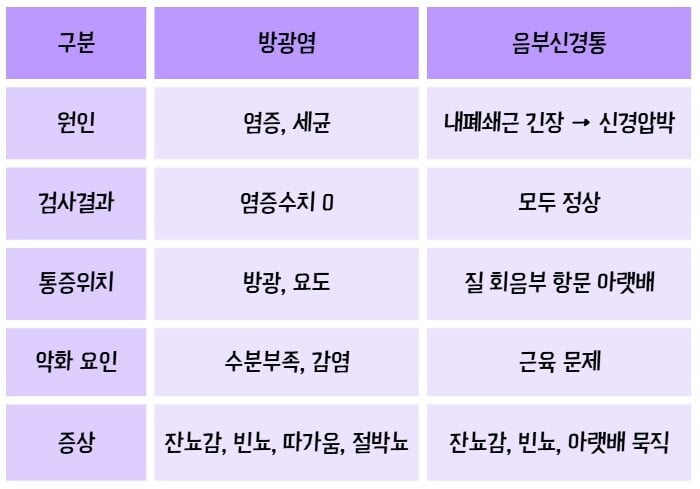
Cystitis typically shows evidence of inflammation on urine tests and often responds to antibiotic treatment. Pudendal neuralgia, on the other hand, is often characterized by no specific abnormalities on examination, pain that worsens when sitting or changes in certain positions, and symptoms that vary in intensity depending on stress or muscle tension.

If your tests are normal and the pain persists, you need to consider both nerve and muscle issues
The absence of abnormalities on examination can be an important clue. In particular, tension and nerve irritation in the muscles around the pelvis are often not easily identified on examination, so it can be helpful to consider these together, as they suggest that the problem may be functional rather than structural.
It’s important to understand the symptoms
Symptoms such as urinary frequency, perineal pain, and bladder discomfort can be caused by a variety of different things, so it’s important to consider both problems with the bladder itself and functional problems with nerves and muscles, rather than single out one cause of your symptoms. This approach can be an important starting point for understanding and managing your symptoms.
You can check it with the pudendal neuralgia self-test!!!