

Table of Contents
Hi, I’m Dr. Sangchul Hwang, an autonomic nervous system researcher and therapist In the interstitial cystitis (IC) community, I often hear stories like,“I’ve been on a low-sodium diet for a few years, but my bladder is more sensitive.” “The more water I drink, the more often I have to go to the bathroom.” “I’ve been adding a little salt to my diet and it’s actually decreased my urinary frequency. Is this weird?”
We’ve long been taught that “salty foods increase inflammation” and that “if you have cystitis, you need to eat fresh.” But why do some patients feel more comfortable with salt? Today, we’re going to do something a little different than conventional wisdom: we’re going to take a look at the relationship between interstitial cystitis and water-electrolytes, based on real patient experiences.

Interstitial Cystitis Isn’t Caused by Salt
Interstitial cystitis is not a single-cause condition. It’s a chronic condition that is caused by a combination of factors, including poor bladder mucosal tissue and function, sensory nerve hypersensitivity, and autonomic imbalance.People with interstitial cystitis are often very sensitive to food. Avoiding capsaicin-acidic foods, for example, can lead to extreme low-sodium diets.Low-sodium diets aren’t necessarily a bad thing in and of themselves, but eating fresh may not always be the answer.
What happens when you drink a lot of kool-aid?
One of the most common pieces of advice we hear in the hospital is “drink lots of water”. Of course, hydration is important, but if you drink too much water, your body will react in the following ways:Your body has a natural tendency to try to maintain a constant level of electrolytes in your blood. When you drink a lot of water, your blood becomes diluted, and your kidneys try to quickly excrete that water into the urine. Naturally, you urinate more often.
The problem is the already sensitive bladder of a person with interstitial cystitis. Repeated urination causes the bladder to contract frequently, and the sensory nerves are repeatedly stimulated, making it easier to activate the micturition reflex, which in turn makes the bladder even more sensitive, creating a vicious cycle.In addition, with repeated urination, not only water is lost, but also electrolytes such as sodium, potassium, and calcium. Normally, the kidneys reabsorb more than 99% of sodium, but in severe cases of oliguria, the amount excreted can be increased, which can upset the stability of body fluids.
This means that even if you’re drinking enough water, you may actually be dehydrated, and this will affect your bladder function.”I’m obviously drinking a lot of water, so why do I feel so dry and weak?” you may be asking yourself. If you’ve ever wondered, “I’m obviously drinking a lot of water, so why do I feel so dry and weak?” this may be your situation.

The key is ‘balance of electrolyte concentration’, not the amount of salt
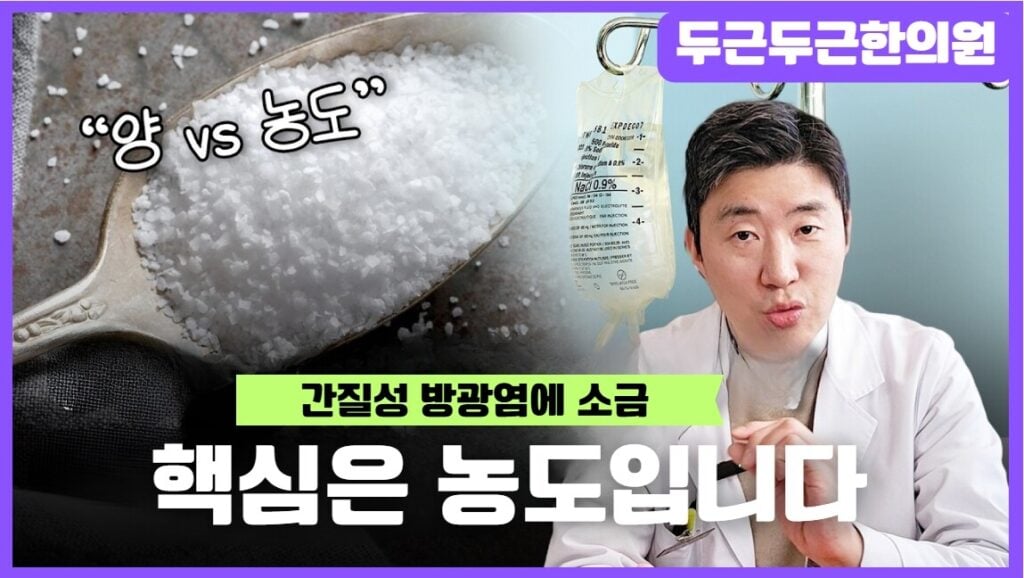
The real key for those who feel comfortable with salt is notthe salt itself , butthe stabilization of the fluid concentration.The concentration of normal saline used in hospitals is 0.9%, which is the most similar to our own body fluids. To put this in perspective, the recommended daily drinking concentration is between 0.3 and 0. 5%, or about 3 to 5 grams of salt per liter of water.Drinking water at this concentration makes it easier for the body to absorb water and maintain electrolyte balance.
- More salt and less water → higher concentration in the body → actually salty
- Drinking only water → diluting electrolytes → worsening oliguria
- The right combination of salt and water → stabilizes concentration → improves water absorption
We’re not saying to make it salty, we’re saying to make it thick.

How do you adjust in real life?
First, drink water in small sips and slowly. Instead of drinking a large amount at once, it’s better to break it up into smaller sips throughout the day. If you urinate more than 10-15 times a day, be sure to check your drinking pattern.
Second, don’t limit the natural salt in your diet to extremes. Going nearly salt-free and drinking only water can actually upset your electrolyte balance. It’s more stable to combine water with the natural salt in your meals.
Third, pair salt and water together. It’s important to consume them together in balance, not salt separately and water separately. The reference concentration is 3-5 grams (0.3-0.5%) of salt per 1 liter of water.
If you absolutely need to consult an expert
Controlling sodium and fluid intake is not the same for everyone. If you fall into any of the following categories, you should consult with your healthcare provider before making a decision.
- People with high blood pressure who are taking diuretics
- Renal failure patients
- Patients with reduced kidney function
- Patients with a past history of electrolyte abnormalities
In this case, arbitrarily changing your sodium-hydration intake could be dangerous to your health.
Today’s Key Takeaways
Interstitial cystitis is not caused by eating too much salt.
Drinking too much plain water can lead to oliguria and electrolyte loss.
The key is the balance of water and electrolytes, not the amount of salt.
A low-salt diet is not always the right answer for all patients with interstitial cystitis.
If you are concerned about your diet and drinking habits, always consult your healthcare provider.
If your bladder is making you cautious and exhausted every day, you may be wondering if you’re going it alone for too long.
We know how tiring it can be to have to worry about every single thing you eat, even a glass of water, but remember that small changes can make a big difference in your bladder comfort🌿.