


Table of Contents
hello. I’m Dr. Sangchul Hwang, a doctor who studies and treats autonomic nerves.I’ve prepared this article about Zelmiron, a treatment for interstitial cystitis. When I treat patients suffering from interstitial cystitis, they often say, “I’ve been taking medication for a long time, but I’m not sure what exactly the effect is.” The treatment process itself can be unnerving because of repeated pain, frequent urination, and urgency. Today, we’ll take a look at how Zelmiron, used to treat interstitial cystitis, affects the bladder.

The basic ingredients and role of gelmyron
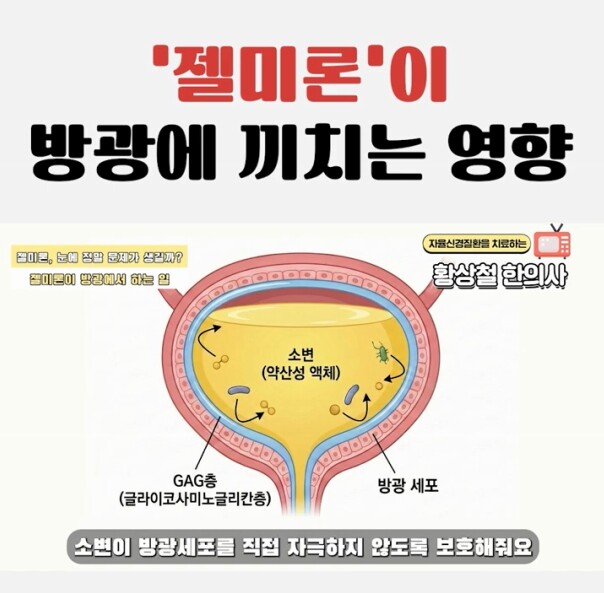
The main ingredient in Zelmiron is sodium pentosan polysulfate, which is known to reinforce the glycosaminoglycan layer of the GAG layer on the surface of the bladder mucosa.The normal bladder mucosa acts as a barrier to protect the mucosa from irritants in the urine. However, in patients with interstitial cystitis, this protective layer is damaged or thinned, allowing irritants such as potassium in the urine to directly irritate the nerves beneath the mucosa. Zelmiron works to reduce the permeability of the bladder mucosa by reinforcing this damaged protective layer like a coating.
Main effects on the bladder
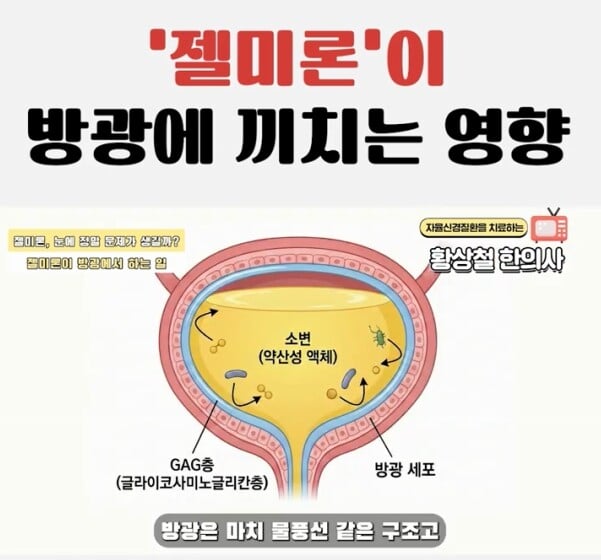
First, increased mucosal protection
Gelmyron binds to the bladder lining to form an artificial barrier, reducing the ability of irritants to directly irritate the nerves.
Second, it reduces inflammatory responses
Some studies report that gelmyron may contribute to reducing microinflammation through its anti-inflammatory and anticoagulant properties. This may indirectly help relieve chronic pain.
Third, reduced pain and frequent urination
As mucosal protection is restored, you should see a gradual decrease in pain intensity, a small increase in bladder volume, and a reduction in urinary frequency. However, these effects often occur gradually over weeks to months.
Limitations of effectiveness
Zelmiron is a drug that focuses on structural mucosal protection.
Therefore
– Autonomic overactivity
– Pelvic floor muscle tension
– Increased central pain sensitivity
– Stressful exacerbations
may not be sufficient in patients with stronger factors, such as the presence of a retinitis pigmentosa. In clinical practice, not all patients respond the same way. There have also been reports of rare pigmentary maculopathy associated with long-term use, and regular eye examinations are recommended.

Clinically significant
Interstitial cystitis is not just a problem with the bladder lining, but is often deeply linked to an overactive autonomic nervous system. This can be seen in how symptoms worsen during stressful situations, or how pain increases after sleep deprivation.
Therefore, Zelmiron is one component of a structural treatment to protect the mucous membrane, and when combined with nervous system stabilization, inflammation control, and pelvic tension relief, the treatment can be more effective.
In summary, Zelmiron is a drug that works by a mechanism that protects the damaged bladder mucosa and has an important role to play in the treatment of interstitial cystitis. However, more reliable improvements can be expected when an integrated approach is taken that takes into account the complex nature of the disease.
If you’re struggling with interstitial cystitis, we hope this article helps you understand your options.
Thank you.