

Table of Contents
hello. I’m Dr. Sangchul Hwang, a researcher and therapist specializing in autonomic nerves. Most people who are thinking about having surgery for hyperhidrosis think, “If I have surgery, I won’t sweat anymore.” I used to think that too, but when I saw patients who started sweating all over their bodies after surgery, and were accompanied by more anxiety, nervousness, and even depression than before, I realized that it was not a simple choice.
What is hyperhidrosis surgery?
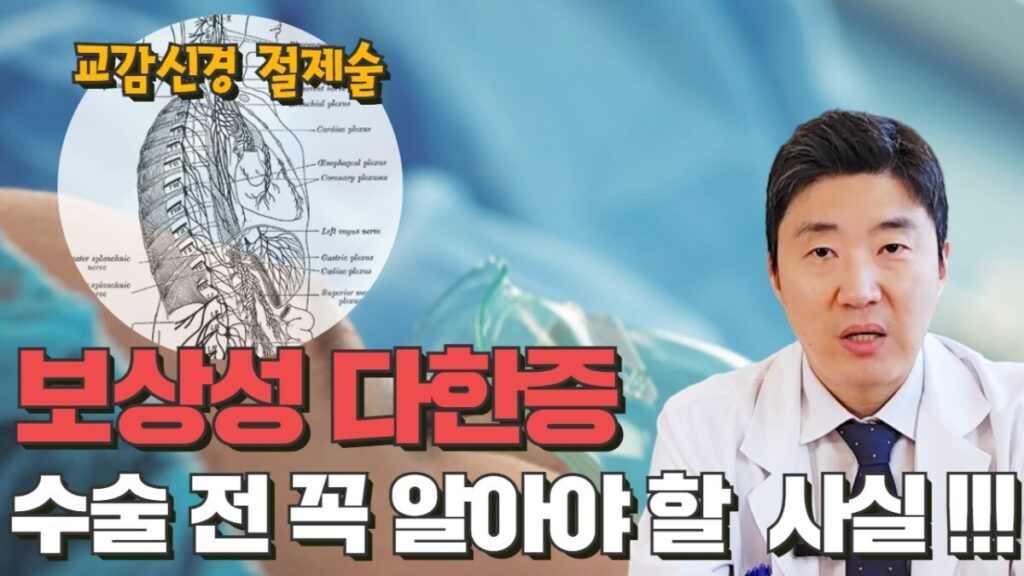
The correct name for the surgery for hyperhidrosis is thoracic sympathectomy. It involves electrocauterizing, cutting, or compressing the T2 to T4 section of the sympathetic ganglion located in the chest with a metal clip to block the sweat signals to the hands and feet. This surgery does not remove the cause of sweating, but rather interrupts the nerve signals that direct sweating.
The Crucial Difference Between T2 and T4 Resections
Anatomically, T2 and T4 have different functions and risk of side effects. T2 ablation is strong enough to stop sweating almost immediately, but it carries the highest risk of compensatory hyperhidrosis. In real-world studies, the incidence of compensatory hyperhidrosis after T2 ablation has been reported to be over 90%, while T4 ablation is less than half that, at around 42%. This is why there is a growing trend to choose T4 ablation to reduce the risk of side effects, even if it is slightly less effective.
Benefits and practical limitations of clipping
Clipping, which involves compressing the nerve with a metal clip rather than cutting it, has the advantage that it can be removed if necessary and some recovery can be expected. However, the incidence of compensatory hyperhidrosis is still high, ranging from 70 to 80%, and often does not return to normal when the clip is removed. Some studies have even reported that compensatory sweating is worse than with clipping.
Compensated hyperhidrosis in real patients
One patient I saw completely lost his hand sweats after T2 ablation, but then sweat started cascading down his back, stomach, buttocks, and thighs, making it impossible for him to wear a suit and forcing him to wear only thin shirts, even in winter. Another patient became very cold after surgery, as if his body chemistry had changed, and he suffered from night sweats, shivering, and extreme anxiety whenever he was cold.
Compensatory Hyperhidrosis Isn’t Just a Sweat Problem
Several papers have reported that compensatory hyperhidrosis is more than just a physical side effect; it can psychologically isolate patients and lead to anxiety disorders and depression. The problem is that these changes are irreversible after surgery.
Are there any other options besides surgery?
Chinese medicine treats patients with preoperative generalized hyperhidrosis and postoperative compensatory hyperhidrosis by regulating the autonomic nervous system and improving constitution. While there are no cures, there are certainly cases of reduced sweating, stabilized emotional responses, and improved quality of life.
Surgery should always be the last option
There is always the potential for side effects with any hyperhidrosis surgery, whether it’s a T4 ablation or clipping, and the greater the expectations, the more anxiety, panic, and depressive symptoms you may experience when side effects occur. Be sure to fully consider autonomic modulation and constitutional therapy before deciding on surgery.