

Table of Contents
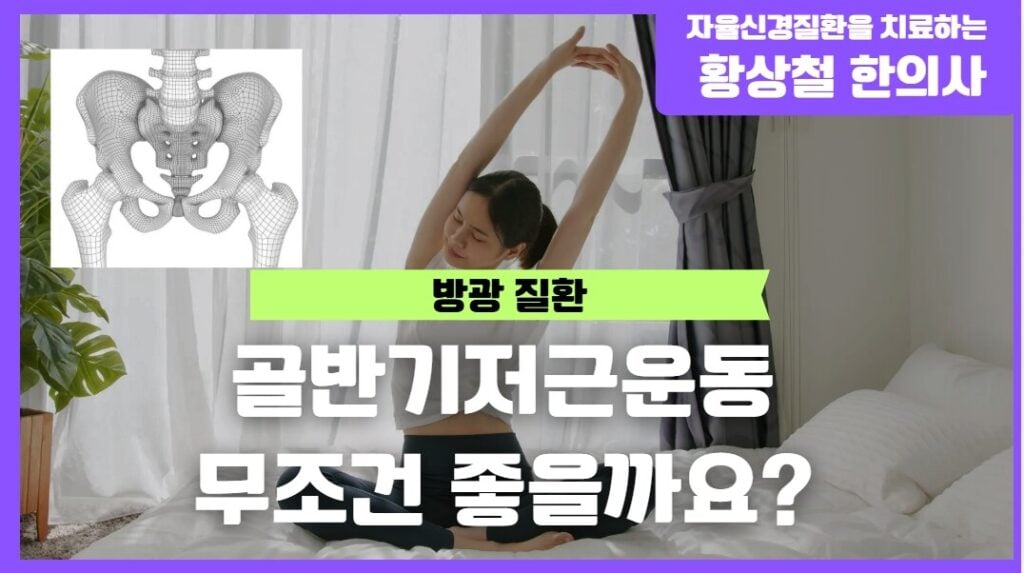
Pelvic floor exercises: Doing more isn’t necessarily better.
Hello. I’m Dr. Hwang Sang-cheol, and I specialize in researching and treating the autonomic nervous system. When I consult with patients who come to the clinic with pelvic pain, there’s a comment I hear frequently. “I’ve been doing pelvic floor exercises because I heard they’re good for me, so why does it hurt even more?” or “Since I started the exercises, I actually feel the urge to urinate more often, and I have a tightening sensation around my anus.” Pelvic floor exercises are widely recognized as beneficial, but they do not work the same way for everyone. Especially for conditions accompanied by pelvic pain—such as interstitial cystitis, levator ani syndrome, pudendal neuralgia, urethral syndrome, and PGAD—it is crucial to first assess the current condition of the pelvic floor muscles. Many people believe that the more they exercise, the better, but if the pelvic floor muscles are already overly tense, repetitive contraction exercisescan actuallycreate a vicious cycle that worsens discomfort.
1. What role do the pelvic floor muscles play in our bodies?
The pelvic floor muscles are extremely important muscles that act like a sturdy hammock, supporting the pelvic organs—such as the bladder, uterus, and rectum—from below. They also play a role in precisely controlling urination and bowel movements, maintaining intra-abdominal pressure, and helping to maintain the body’s core balance. The pelvic floor muscles react naturally and unconsciously when we cough or lift heavy objects, and they are constantly active even during everyday activities like walking or sitting. Therefore, these muscles can only maintain a comfortable state when they smoothly alternate between normal contraction and relaxation. However, the problem is that issues with these muscles do not always stem from weakness. In fact, in clinical practice, we encounter quite a few cases where the muscles are excessively tense and stiff, rather than weak.
2. Uncomfortable Symptoms Caused by Overly Tense Pelvic Floor Muscles
When the pelvic floor muscles remain constantly tense without any rest, microcirculation within the muscles decreases, and the surrounding nerves inevitably become hyperactive and hypersensitive. In this state, a wider range of symptoms than one might expect can arise. Typical symptoms include a frequent urge to urinate, a sensation of incomplete emptying even after urination, a heavy feeling in the perineum and a tight, pulling pain inside the anus, difficulty sitting for long periods, pain that intensifies after sexual intercourse, and a heavy or burning sensation deep within the pelvis. At first glance, these symptoms may seem like problems with the bladder or urethra itself, but in reality, they are very often caused by chronic over-tension in the pelvic floor muscles, which stimulates the nerves and contributes to the symptoms.
3. The Close Relationship Between Pelvic Pain Disorders and the Pelvic Floor Muscles
In patients with interstitial cystitis, it is common to find not only sensitivity in the bladder lining but also pelvic floor muscles that are tense as a rock. When bladder pain recurs, our bodies unconsciously contract and tense the surrounding muscles to reduce pain and protect the organs. Although this initially serves as a defense mechanism to protect the body, if this state persists for a long time, the muscles become stiff and rigid, creating a vicious cycle in which they actually trigger more pain. Therefore, in this situation, it is important to first accurately assess the current level of muscle tension rather than performing exercises that squeeze the muscles.
This principle applies equally to anal sphincter syndrome, in which patients complain of pain or a feeling of pressure deep inside the anus. In particular, if your symptoms worsen when you sit for long periods and improve slightly when you stand up, it means the muscles around your anus are already contracting excessively. Adding repetitive contraction exercises to this situation is like adding fuel to the fire. The same applies to pudendal neuralgia and PGAD, which are responsible for sensation in the perineum, vulva, and anal region. Since these important nerves pass through the narrow space inside the pelvis, excessive tension in the surrounding muscles can compress the nerves, intensifying burning pain, numbness, or tingling sensations.
4. Exercise designed to build strength can be harmful for patients with muscle hypertonicity.
When people hear the term “pelvic floor exercises,” most tend to think only of exercises like Kegel exercises, which involve repeatedly tightening and contracting the anal muscles. However, if you continue to have someone whose muscles are already overly contracted—beyond their limits—perform exercises that require sustained contraction, the muscles will forget how to relax and become even more tightly knotted. In particular , exercises that involve holding your breath while strongly increasing abdominal pressure, continuously applying strong force to the anus and urethra, creating excessive tension in the abdominal muscles, or repeating movements despite feeling pain can be harmful depending on your current condition, so special caution is required. Exercise itself isn’t bad; what’s important is first determining whether the exercise is appropriate for your current muscle condition.
5. What kind of exercise does my body really need right now?
If your pelvic floor muscles are overly tense and causing pain, your top priorityshould be “relaxation exercises that completely release tension, ”rather than exercises that further tighten the muscles. Relaxation stretches that reduce tension around the pelvis—combined with gentle abdominal breathing—along with correcting poor posture and light exercises that restore the natural movement of the pelvis and hips, are actually very helpful in improving blood flow to the muscles and soothing hypersensitive nerves. However, specific exercise methods must be carefully tailored to the patient’s symptoms and underlying causes. Therefore, if pain intensifies or urinary symptoms worsen after exercising, you should stop immediately, consult a specialist, and select a customized relaxation treatment suited to your condition.
Wise Treatment That Listens to My Body’s Signals
Pelvic pain is not simply a localized issue involving just one pelvic muscle. It is a complex result of numerous intertwined factors, including the patient’s daily posture and breathing patterns, the alignment of the spine and pelvis, the balance of the autonomic nervous system, and chronic stress. Therefore, rather than blindly repeating exercises that others say are effective, the proper starting point for treatment is a process of carefully assessing the current condition of your body.
If you suffer from conditions accompanied by pelvic pain—such as interstitial cystitis, anal sphincter syndrome, pudendal neuralgia, urethral syndrome, or PGAD—first assess whether your pelvic muscles are currently weak and lacking strength, or whether they are stiff and tense due to exhaustion and stress. If your symptoms haven’t improved despite regularly doing pelvic floor exercises—or if the lower part of your body has actually become stiffer and more uncomfortable— it’s time to check with a specialist to ensure your exercises are on the right track, rather than simply increasing the volume of your workouts. Please feel free to reach out anytime you’re deeply troubled by pelvic pain or autonomic nervous system issues. Thank you.