

Table of Contents
hello. I’m Dr. Sangchul Hwang, a researcher and doctor of autonomic nervous system. Many patients with hyperhidrosis often ask me, “Will surgery change my constitution?” We see a lot of cases where people who were hot become very cold after surgery, or conversely, people who were cold become very hot after surgery. So today, I’d like to talk about the phenomenon of what appears to be a change in constitution after surgery, the underlying constitution that does not change, and why compensatory hyperhidrosis comes with mental aftereffects.
Surgery doesn’t change your constitution
One thing has become clear to me in treating many patients with compensated hyperhidrosis. If you’re a hot person, you’re still a hot person after surgery, and if you’re a cold person, you’re still a cold person after surgery. However, the aspect of the constitution, or how it is expressed, changes. For example, a febrile person becomes a cold-sensitive person after surgery, or a cold-sensitive person becomes a feverish person after surgery, or vice versa.
Only the spectrum of the constitution changes
A Yang person is still a Yang person, and a Taiyin person is still a Taiyin person. However, after surgery, the direction of heat sensation, the area of sweating, and the spectrum of symptom response are different within the constitution, so even though the treatment principle is the same, the symptoms are completely different, and the patient feels as if the constitution has changed.
In compensatory hyperhidrosis, the scarier thing is the ‘psychological aftermath’
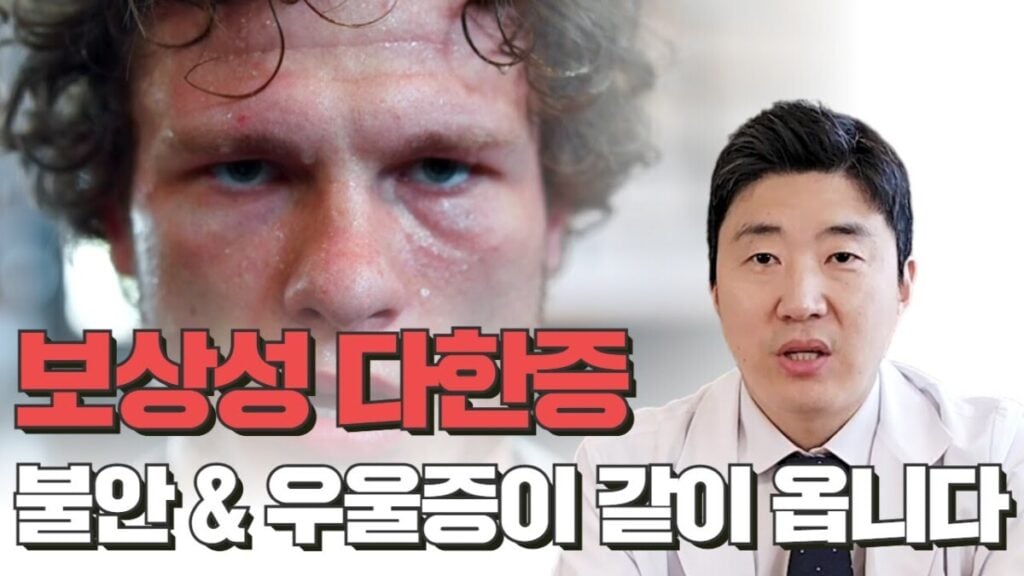
Even more challenging than the physical sweating are the psychological changes that occur with compensatory hyperhidrosis. It’s not uncommon for patients to find that their sweating has actually stopped, but instead they’re left with cold sweats, nervousness around people, and even psychiatric medications. At this point, treatment becomes much more challenging. It’s not just about reducing sweating, it’s about treating autonomic nerves, emotional responses, and thought patterns.
Compensatory HyperhidrosisHyperhidrosis Systemic Hyperhidrosis, Sympathetic Nerve Surgery – 두근두근한의원
So the treatment of compensated hyperhidrosis is approached differently
Compensated hyperhidrosis is not just a sweating problem, but a combination of autonomic anxiety, tension, and emotional overreactivity that requires a more nuanced and sensitive treatment approach. Even if you use the same treatment principles as before surgery, the recovery process and depth of treatment will be completely different.
Chinese medicine recognizes constitution and stabilizes the autonomic nervous system
In Chinese medicine, “stabilizing the autonomic nerves within the constitution, rather than trying to change the constitution,” is at the center of treatment, so patients with postoperative compensatory hyperhidrosis are often treated with a combination of constitutional and emotional regulation of the autonomic nerves.
Restoring quality of life is more important than a cure
I don’t often use the word “cure” for people with compensatory hyperhidrosis, but I’ve seen many people who have regained their quality of life, overcome tension and anxiety, and gotten back to their lives. If you’re considering surgery, or if you’re already experiencing difficult symptoms after surgery, remember that there is a path to understanding your body and working with your autonomic nervous system.