


Anal pain that doesn’t get better with ointments and sitz baths
hello.
I’m Dr. Sangchul Hwang, an autonomic nervous system researcher and therapist.
You have a bowel movement but don’t feel any relief afterward,
A heavy pressure on the inside of the anus when sitting in a chair,
and sometimes a sharp, nerve-tingling pain that lingers throughout the day.
Some people experience discomfort throughout the day.
Most people’s first thought is.
“I must have hemorrhoids.”
So you apply ointments and take sitz baths.
Days and weeks go by with no significant change.
You’re told over and over again that there’s nothing wrong with you.
In such cases
Beyond the problem with the anus itself,
we need to look at the nerve and muscle tension together.
────────────────
What is anal sphincter syndrome?
Anal sphincter syndrome is
is a condition in which the deep muscle layers surrounding the anus and rectum
and the nerves that run through them become overly tense
causing pain and discomfort.
No visible wounds or bleeding,
and endoscopy or basic examination
endoscopy or basic examination.
So patients may ask
“If there’s nothing wrong, why is it so uncomfortable?”
if there’s nothing wrong with them.
But that doesn’t mean it’s asymptomatic.
It’s just not a visible structural lesion,
functional problems with nerves and muscles
nerves and muscles that can cause pain that is strong enough to be recognized.
────────────────
Why it’s often confused with hemorrhoids
Anal sphincter syndrome is most often confusing because
because the symptoms are very similar to hemorrhoids.
A feeling of residual stool left behind after a bowel movement,
a heavy feeling of pressure inside the anus
Occasional sharp sphincter pain.
Outwardly, it’s hard to tell hemorrhoids apart.
But there’s an important difference.
Ointments and sitz baths don’t make a difference,
The more you sit, the more uncomfortable you become,
and relatively comfortable when lying down.
the pain is likely caused by nerve and muscle tension
nerve and muscle tensionrather than asimple anal condition.
────────────────

The key is stimulation of the perianal nerve
The key nerve responsible for sensation in the anus and rectum is the
pudendal nerve is the inferior rectal nerve.
This nerve runs
passes very close to the anal sphincter, pelvic floor muscles, and lymphatic structures.
the surrounding muscles are easily irritated
even the slightest tension in the surrounding muscles.
Muscles become stiff
lymph and blood circulation decreases
nerves become sensitive
The result is pain, residual sensations, and discomfort.
In other words, it’ s not that the nerve itself is damaged, it’s that the environment
the nerve is traveling through is bad.
────────────────
Why sitting for long periods of time hurts more
Many people ask
“Is it because I’ve been sitting for a long time?”
Yes, but
It’s not just about sitting time.
Sitting for long periods of time,
driving, or office work,
and a tendency to be stressed out
the sympathetic nervous system is constantly fired up.
When the sympathetic nervous system is triggered
muscles are unable to relax and remain tense.
This tension travels down to your buttocks and pelvic floor muscles.
The deep muscles around the anus also tighten.
So
The more you sit, the more uncomfortable you are,
and then it gets better when you move or lie down.
when you move or lie down.
────────────────
Why symptoms are not limited to the anus
Anal sphincter syndrome
The pain often doesn’t stay in the anus.
The inferior rectal nerve is
is connected to the sacral plexus
to the buttocks, lower back, and back of the thighs.
to the buttocks, lower back, and back of the thighs.
Some people experience
Feeling uncomfortable in the bladder,
urgency, and urge urination.
Because of this
back problems, bladder problems, or other pelvic pain
other pelvic pain.
────────────────
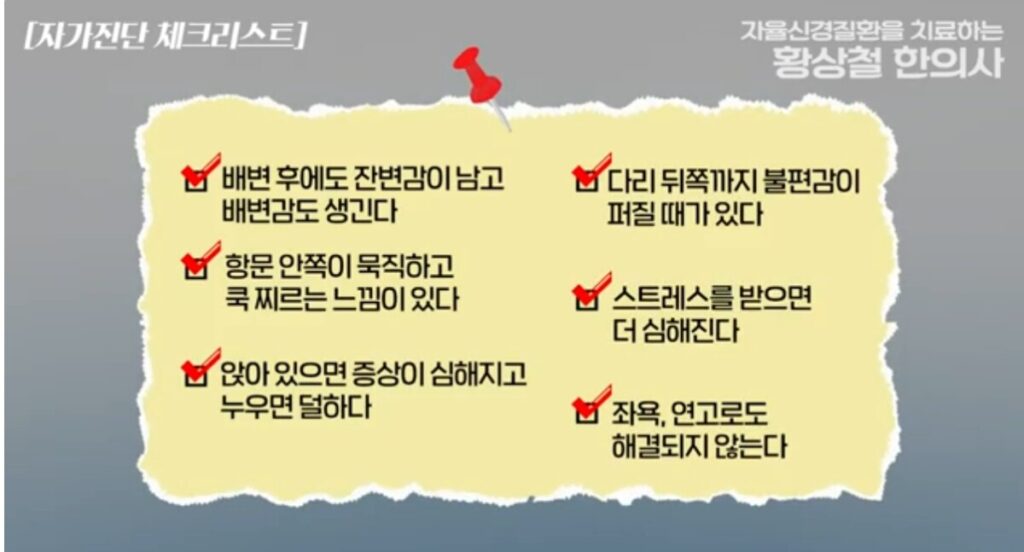
Anorectalis Syndrome Self-Checklist
If
three or more of the following
you may have anal sphincter syndrome.
✔️ A loose feeling lingers after a bowel movement
✔️ A heavy or stabbing sensation deep inside the anus
✔️ Worse when sitting and easier when lying down
✔️ Discomfort sometimes radiates to the back of the thigh or buttocks
✔️ Symptoms are worse during times of stress
✔️ Ointments and sitz baths don’t make much difference
────────────────
I approach it like this
This condition is
treatments that only look at the area of pain
slow to improve or have frequent flare-ups.
I don’t just look at the anus locally.
I look at the entire nerve flow, including the spine, sacrum, pelvis
including the spine, pelvis, and pelvis.
Acupuncture and Medicated Needle Therapy
to relax tense nerves and muscles,
chiropractic adjustments
to realign the pelvis and sacrum together.
The sacral region in particular is a key pathway for the
is a key pathway for the pudendal nerve.
so releasing tension in this area
is important for recovery.
────────────────
Why you should look at constitution and environment together
Anal sphincter syndrome
does not happen to everyone.
Sympathetic nervous system prone to hyperactivity,
a stressful environment,
and a lifestyle that lacks recovery time
more likely to occur.
So rather than taking a pain-only approach
it’s important to address the entire body’s tension patterns
and autonomic balance of the entire body.
────────────────
Wrapping up
Anal pain that doesn’t go away with ointments and sitz baths
can be a clear signal from your body.
Rather than dismissing that signal as
“Oh, it’s not a big deal,” but instead of dismissing it as
why it repeats,
and what structures and tensions are involved.
the path to recovery becomes much clearer.
You’re not alone in your discomfort
that you’re not alone,
and that the way you approach it
can make a big difference
the way you approach it.